
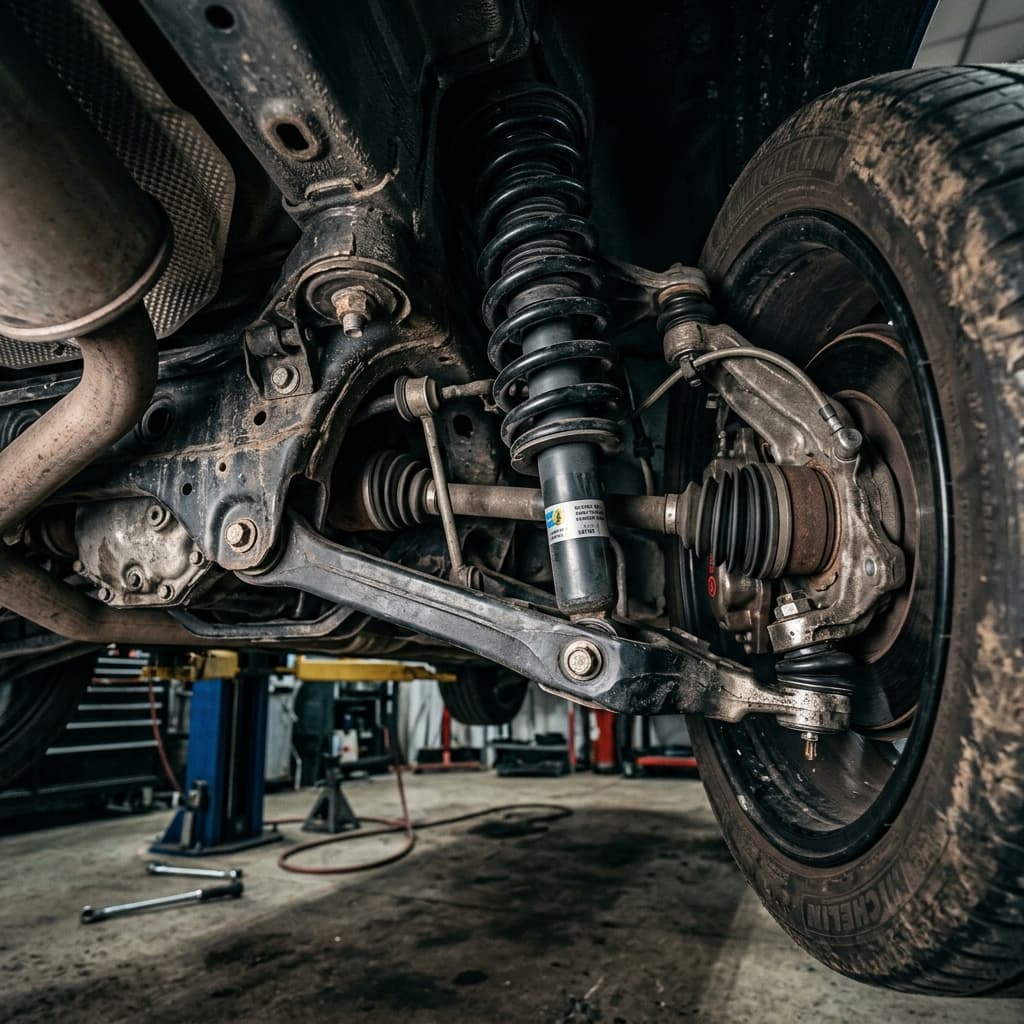
Struts and shocks are both damping components — they control how the suspension moves — but they're not the same thing. Using the terms interchangeably is understandable, but it leads to confusion when it's time for service, because the repair is different, the cost is different, and not all vehicles have both.
What Shock Absorbers Do
A shock absorber (damper) does one job: it controls the speed at which the suspension moves. Without shocks, a spring would bounce the wheel up and down repeatedly after hitting a bump — you'd feel every road imperfection as a series of oscillations. The shock absorber uses hydraulic resistance to limit that movement and return the wheel to its normal position quickly and smoothly.
A shock absorber is a standalone component — it attaches between the suspension and the vehicle body or frame, but it doesn't carry any of the vehicle's structural load. The spring (coil spring or leaf spring) carries the weight; the shock controls the spring's movement.
What Struts Do
A strut combines the shock absorber function with a structural role. The strut is part of the suspension's load path — the vehicle's weight is transferred through the strut to the wheel. Struts also typically integrate the spring (in a coil-over design) and the steering knuckle on the front, meaning they're part of the steering geometry. Replacing a strut almost always requires a wheel alignment afterward because the suspension geometry shifts.
This structural function is the key difference. You can remove a shock absorber and the vehicle's weight is still supported by the spring and other suspension components. You can't remove a strut without the suspension collapsing.
Which Does Your Vehicle Have?
Most modern front-wheel-drive and all-wheel-drive vehicles use struts in the front and often the rear. Rear-wheel-drive trucks and body-on-frame SUVs more commonly use separate shocks and springs. Many vehicles use struts in the front and shocks in the rear.
The simplest way to check: look at your front suspension. If you see the shock/spring unit bolted to the steering knuckle and running up through a mount in the strut tower at the top of the wheel well — that's a strut. If you see a separate coil spring and a thin shock absorber cylinder — those are separate components.
Symptoms of Worn Shocks or Struts
The symptoms are similar for both — they're doing the same job, just in different configurations:
Excessive bouncing after bumps. The bounce test: push down hard on one corner of the car and release. The car should settle in 1–2 bounces. Three or more bounces = that damper is worn. Repeat all four corners.
Nose-diving under braking. The front of the car dips dramatically when you apply the brakes. This is the front struts or shocks failing to control weight transfer — it also increases stopping distance.
Body roll in corners. Excessive leaning when cornering, especially at moderate speeds. The dampers should be limiting body roll, not allowing the car to tip toward the outside of the turn.
Steering wheel vibration or wandering. Worn struts affect steering precision because they're part of the steering geometry. Vague, imprecise steering or highway-speed wandering often traces to front struts.
Uneven tire wear. Cupped or scalloped tire wear (a repeating pattern of high and low spots) is a classic sign of a worn shock or strut — the tire is literally bouncing on the road surface instead of maintaining consistent contact.
Visible leaking. A shock or strut body that's wet with hydraulic fluid has a failed seal. The fluid is what provides the damping force — a leaking damper is already degraded.
Clunking or knocking over bumps. This is more often a strut mount or bushing failure — the top or bottom attachment points — rather than the damper itself. But it means the strut assembly needs inspection.
How Long Do They Last?
There's no universal replacement interval because driving conditions vary enormously. General guidelines:
Shocks: 50,000–100,000 miles under normal conditions. Georgia's roads and highway speeds favor the longer end. Off-road or frequent rough road driving shortens lifespan significantly.
Struts: 50,000–100,000 miles similarly. Front struts on a front-wheel-drive vehicle carrying heavier load tend to wear faster than rear struts.
The 50,000-mile inspection rule: Have a suspension inspection — including a bounce test and visual check for leaks — at every 50,000-mile interval, or any time you notice the symptoms above.
Strut and Shock Replacement Costs
| Service | Typical Cost | Notes |
|---|---|---|
| Shock absorbers (pair) | $150–$400 | Labor is relatively simple on most separate-shock configurations |
| Strut replacement (pair, front) | $450–$900 | Includes spring compression, mount, and alignment |
| Strut replacement (pair, rear) | $350–$700 | Often less labor-intensive than front |
| Wheel alignment (after front strut replacement) | $100–$175 | Always required — struts are part of steering geometry |
| Complete strut assembly (quick-strut) | $500–$1,000/pair | Pre-assembled unit with spring and mount — faster installation |
Why replace in pairs? If one shock or strut has worn to the point of needing replacement, the opposite side has experienced the same mileage and conditions. Replacing only one leaves the vehicle with mismatched damping — one side settles quickly, the other bounces. The car handles unevenly, and the new component wears faster trying to compensate. Always replace axle pairs: both fronts or both rears together.
Quick-strut assemblies: Many vehicles now have pre-assembled strut units (sometimes called "quick-strut" or "loaded strut") that include the strut, spring, mount, and upper bearing pre-assembled. They cost more than individual components, but reduce labor time and avoid the need for a spring compressor — which makes the job safer and sometimes cheaper overall.
Our steering and suspension service includes a full suspension inspection — bounce test, visual inspection for leaks and damage, and checking for play in ball joints and bushings — before recommending any replacement.
Frequently Asked Questions
Can I drive with bad struts or shocks?
Short distances, cautiously — yes. But worn struts and shocks compromise handling, braking distance, and tire contact with the road. In an emergency stop or sudden swerve, degraded dampers reduce your ability to control the vehicle. The longer you wait, the more your tires wear unevenly and the more stress other suspension components absorb. It's not a crisis repair, but it's not indefinitely deferrable either.
Do I need an alignment after replacing shocks?
After replacing shocks only — not necessarily, if the shocks are separate from the steering knuckle. After replacing struts — yes, always. Struts are part of the steering geometry; any movement in that assembly changes alignment angles. Skipping the alignment after a strut replacement guarantees uneven tire wear.
What's the difference between replacing struts and doing an alignment?
Different jobs. Strut replacement is a mechanical repair — removing and installing the damper/spring assembly. Alignment is a calibration — measuring and adjusting the angles at which the wheels contact the road. Replacing struts often changes alignment angles, which is why an alignment follows. An alignment alone doesn't fix worn struts.