
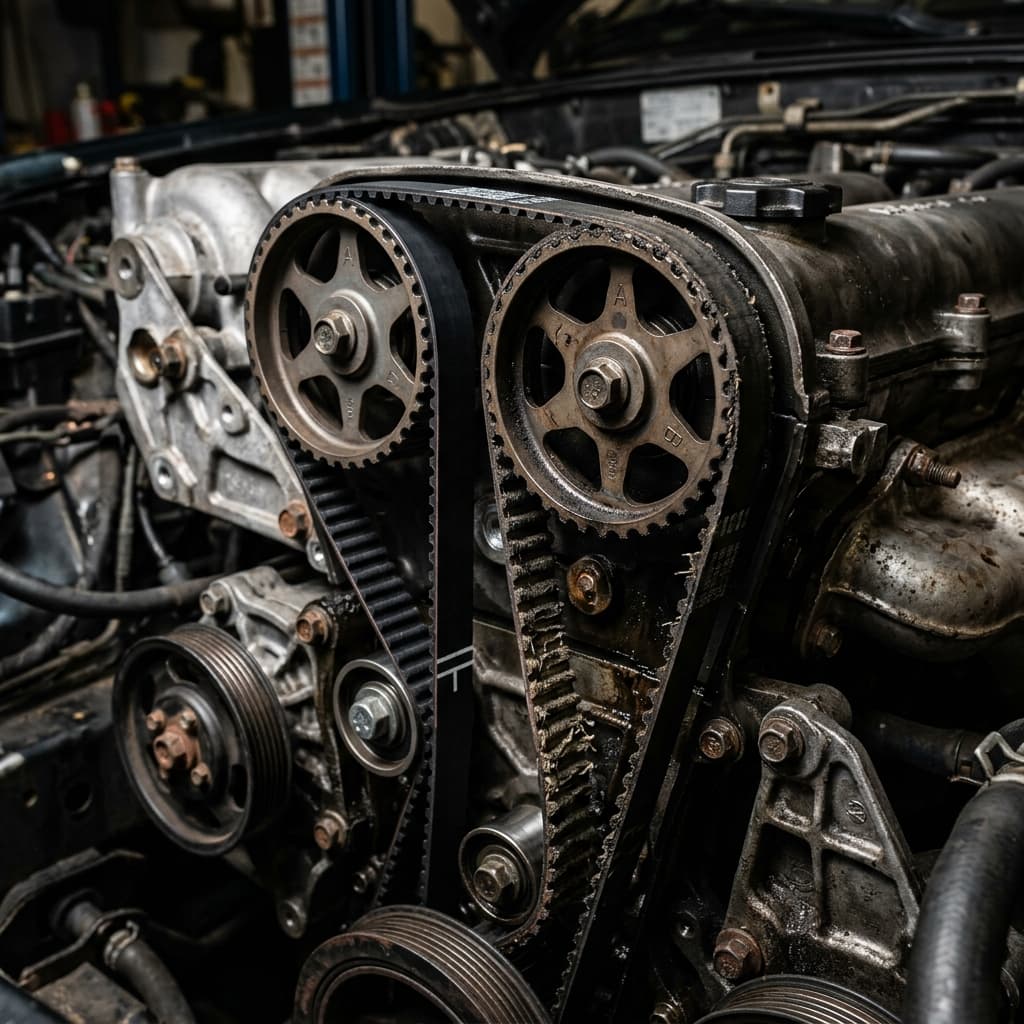
Most drivers have no idea which one their engine has — and it matters enormously for maintenance planning. A timing belt has a mandatory replacement interval. A timing chain is designed to last the life of the engine. Mix them up and you're either spending money on service you don't need, or you're gambling with an engine that's one missed appointment away from catastrophic failure.
This guide breaks down what each one does, how to figure out which one your car has, and what the real consequences are of getting it wrong.
What Do They Both Do?
Both the timing belt and the timing chain do the same job: they synchronize the crankshaft and the camshaft so that the engine's valves open and close at exactly the right moment relative to the pistons.
The crankshaft drives the pistons up and down. The camshaft controls when the intake and exhaust valves open. If those two shafts get out of sync — even slightly — the engine runs rough, loses power, and throws codes. If they get drastically out of sync, the pistons physically collide with the open valves. On most modern engines, that means a destroyed engine.
Both components sit inside a timing cover on the front of the engine. You can't see them without disassembly, which is part of why people lose track of which one they have.
Timing Belt: Key Facts
A timing belt is a reinforced rubber belt with teeth molded into the inner surface. Those teeth mesh with sprockets on the crankshaft and camshaft to maintain precise timing. The belt runs dry — no lubrication — which is why it's made from rubber compounds designed to handle heat and friction without oil.
What that means for maintenance: Rubber degrades. Heat cycles, age, and mileage break down the belt's structure. Timing belts don't give you much warning before they fail — they don't squeal, they don't slip, they don't leave a puddle on your garage floor. They snap. When a timing belt snaps, the engine stops immediately and, depending on the engine design, the damage is either inconvenient or catastrophic.
Key characteristics:
- Made of reinforced rubber with molded teeth
- Runs dry — no oil lubrication
- Quieter and lighter than a timing chain
- Mandatory replacement interval: typically every 60,000–100,000 miles or 7–10 years, whichever comes first — check your owner's manual for your exact spec
- Fails without warning — belts snap, they don't gradually slip
- When replacing a belt, the water pump, tensioner, and idler pulleys are almost always replaced at the same time since the labor overlaps significantly
Commonly belt-driven engines:
- Honda/Acura 4-cylinder and V6 (most engines through 2012)
- Toyota 4-cylinder (pre-2005)
- Subaru (most models through ~2011)
- Mitsubishi (most)
- Hyundai/Kia older 4-cylinders
- VW/Audi TDI diesel and some TSI gasoline engines
- Mazda (some)
Timing Chain: Key Facts
A timing chain is a metal roller chain — similar in concept to a bicycle chain — that links the crankshaft and camshaft sprockets. Unlike a belt, it runs in an oil bath and is lubricated continuously by the engine's oil system.
What that means for maintenance: Timing chains are designed to last the life of the engine. There is no scheduled replacement interval. Under normal operating conditions with regular oil changes, a timing chain can easily go 200,000+ miles without issue.
The catch: "Regular oil changes" is doing a lot of work in that sentence. Timing chains are tensioned by a hydraulic tensioner that relies on oil pressure. Dirty, degraded oil and low oil levels reduce that pressure. The result is a chain that doesn't stay properly tensioned, stretches over time, and eventually slips on the sprocket teeth — retarding or advancing timing in ways the engine can't compensate for.
Key characteristics:
- Metal roller chain running in an oil bath
- Heavier and noisier than a belt — normal to hear a brief rattle on cold start
- No scheduled replacement — designed to last the engine's life
- Can fail from oil neglect — stretched or worn chains cause timing drift and, on interference engines, the same catastrophic outcome as a broken belt
- Warning signs of a failing chain: rattling noise on cold start that takes longer than usual to go away, rough idle, check engine light with codes P0008, P0009, P0016, or P0017
Commonly chain-driven engines:
- Most GM engines (Chevy, GMC, Buick, Cadillac)
- Most Ford engines (F-150, Mustang, Explorer)
- Most Chrysler/Dodge/Ram engines
- Honda/Acura (most engines from 2012 onward)
- Toyota (most V6 and V8, and 4-cylinders from ~2005+)
- BMW (most 6-cylinder and 8-cylinder engines)
- Most modern Hyundai/Kia engines
How to Tell Which One Your Car Has
You don't need to open the engine to find out. Here are five ways to get a definitive answer:
1. Check your owner's manual. Look in the scheduled maintenance section. If there's an entry for "timing belt replacement" at a specific mileage interval, you have a belt. If there's no such entry, you almost certainly have a chain.
2. Search it online. Type "[year] [make] [model] timing belt or chain" into any search engine. This is publicly documented information for every production engine. You'll get an immediate answer.
3. If your maintenance schedule has a replacement interval, it's a belt. Timing chains don't have replacement intervals. That's the simplest rule.
4. Ask your mechanic. Any shop worth going to can tell you in seconds. It's basic knowledge for any technician who works on your make.
5. Listen on a cold start. A timing chain will often rattle briefly on a cold start as oil pressure builds — usually goes away within a few seconds. Timing belts are silent. This isn't a definitive test, but it's a data point.
Quick Reference: Belt or Chain by Make/Model
| Make / Model | Engine | Belt or Chain |
|---|---|---|
| Honda Civic / Accord (pre-2002) | 4-cyl | Belt |
| Honda Civic / Accord (2003+) | 4-cyl | Chain |
| Toyota Camry (pre-2002) | 4-cyl | Belt |
| Toyota Camry (2002+) | 4-cyl | Chain |
| Subaru (most models through ~2011) | All | Belt |
| Subaru (most models 2012+) | All | Chain |
| Ford F-150 | V6 / V8 | Chain |
| Chevy / GMC (most) | V6 / V8 | Chain |
| VW / Audi TDI / some TSI | Various | Belt |
| BMW (most) | 6-cyl / 8-cyl | Chain |
| Hyundai / Kia (older 4-cyl pre-2011) | 4-cyl | Belt |
| Hyundai / Kia (most 2011+) | 4-cyl | Chain |
When in doubt, confirm with your specific engine code — some models used different engines in different years and trim levels.
Interference vs. Non-Interference: The High-Stakes Part
This is where the real danger lives. Engines fall into two categories based on whether the pistons and valves share the same physical space at different points in the engine cycle.
Interference engine: The piston travels high enough in the cylinder that, if a valve were open at the wrong moment, the piston would hit it. When a timing belt snaps or a chain slips far enough on an interference engine, the camshaft stops while the crankshaft keeps turning — and pistons collide with open valves. The result: bent valves, cracked valve seats, damaged pistons, and potentially a scored cylinder head. Engine rebuild or replacement territory.
Non-interference engine: The pistons and valves don't share space. If the belt breaks, the engine stalls immediately — you're stranded, you need a tow and a new belt — but there's no internal damage. You drive away after a relatively straightforward repair.
The critical point: Most modern engines are interference designs. The efficiency gains that come from higher compression ratios require valves to travel deeper into the combustion chamber. If your car is post-2000 and has a timing belt, assume it's an interference engine unless you've confirmed otherwise. The consequences of a broken belt on an interference engine are not minor.
Timing chains on interference engines can cause the same catastrophic failure — not from a snap, but from gradual stretch and timing drift caused by oil neglect. The engine won't stop suddenly; it'll run rough, misfire, and throw codes before it fails — but the internal damage potential is identical.
Which Is Better: Belt or Chain?
The honest answer is that neither is inherently superior. Both work well when they're maintained correctly. The differences are in what "correctly maintained" looks like for each.
The case for timing chains: No scheduled replacement means one less major service interval to track and budget for. On a high-mileage vehicle you're planning to keep, a chain drivetrain is genuinely lower-maintenance — assuming you're changing your oil on schedule. Long-haul ownership favors chains.
The case for timing belts: A belt gives you a known, predictable replacement schedule. You know exactly when service is due. There's no ambiguity. Done on time, a belt replacement is a manageable cost — typically $500–$1,000 for most vehicles when combined with the water pump and tensioner.
Where each one gets people into trouble:
- Belts: Owners who don't know they have one, or who defer service because the car "seems fine." The belt doesn't warn you.
- Chains: Owners who skip oil changes or run low on oil. The chain slowly stretches, timing drifts, and by the time codes appear, wear is already significant.
If you're buying a used vehicle, these are different risks to evaluate. A used car with a belt-driven engine needs documented belt replacement history. A used car with a chain-driven engine needs oil change history — and ideally a cold-start check for chain rattle.
What Happens If You Miss Timing Belt Replacement?
This is worth being direct about, because the cost difference between acting and waiting is enormous.
On a non-interference engine: The belt snaps, the engine stalls, you're stranded. You get a tow and a new belt. Total damage: a few hundred dollars plus the tow and the inconvenience. Aggravating, but recoverable.
On an interference engine (most modern engines): The belt snaps. Pistons hit open valves. Depending on how fast the engine was turning and which valves were open, you're looking at some or all of the following:
- Bent or broken valves
- Damaged valve seats and guides
- Cracked or damaged pistons
- Scored cylinder head
- Possible damage to the camshaft
Repair costs for this kind of damage typically run $3,000–$8,000+ depending on the engine and what exactly failed. On many older vehicles, a bent-valve scenario makes the car a total loss — the repair cost exceeds the car's value. All of that is preventable with a $500–$1,000 service done on schedule.
If your car has a timing belt and you don't know when it was last replaced — or you're approaching the interval — our timing belt service page covers what the job involves and what gets replaced along with it. Don't guess on this one.
Frequently Asked Questions
How do I know if my car has a timing belt or timing chain?
The fastest way: open your owner's manual and look for a timing belt replacement entry in the scheduled maintenance section. If it's there, you have a belt. No entry means chain. You can also search "[year] [make] [model] timing belt or chain" — it's well-documented for every production engine. Any shop can also tell you in seconds.
Do timing chains need to be replaced?
Not on a schedule — they're designed to last the engine's life. However, they can wear prematurely if oil changes are neglected or if the engine runs low on oil. If you're hearing a rattle on cold start that takes 5–10 seconds or more to go away, or if you're seeing P0008, P0009, P0016, or P0017 codes, get the chain and tensioner inspected. Catching it early is a $400–$800 repair. Ignoring it on an interference engine is an engine.
What are the symptoms of a failing timing chain?
The most common early sign is a metallic rattling on cold start that takes longer than a few seconds to go away — that's the chain slapping because the tensioner is slow to build pressure on a worn chain. Other symptoms include rough idle, hesitation on acceleration, poor fuel economy, and check engine codes P0008, P0009, P0016, or P0017 (cam/crank correlation codes). Late-stage failure produces constant rattling, severe misfires, and eventually stalling.
How long does timing belt replacement take?
Typically 2–4 hours of shop time for most 4-cylinder engines. V6 engines with timing belts (Honda V6, some Toyota V6) can run 4–6 hours due to the complexity of the job. The labor time is why it makes sense to replace the water pump, tensioner, and idler pulleys at the same time — they're already accessible, and the incremental cost is small compared to doing the job twice.
If you're unsure what you have or when it's due, bring it in. We'll look it up, check your records, and give you a straight answer on where you stand.