
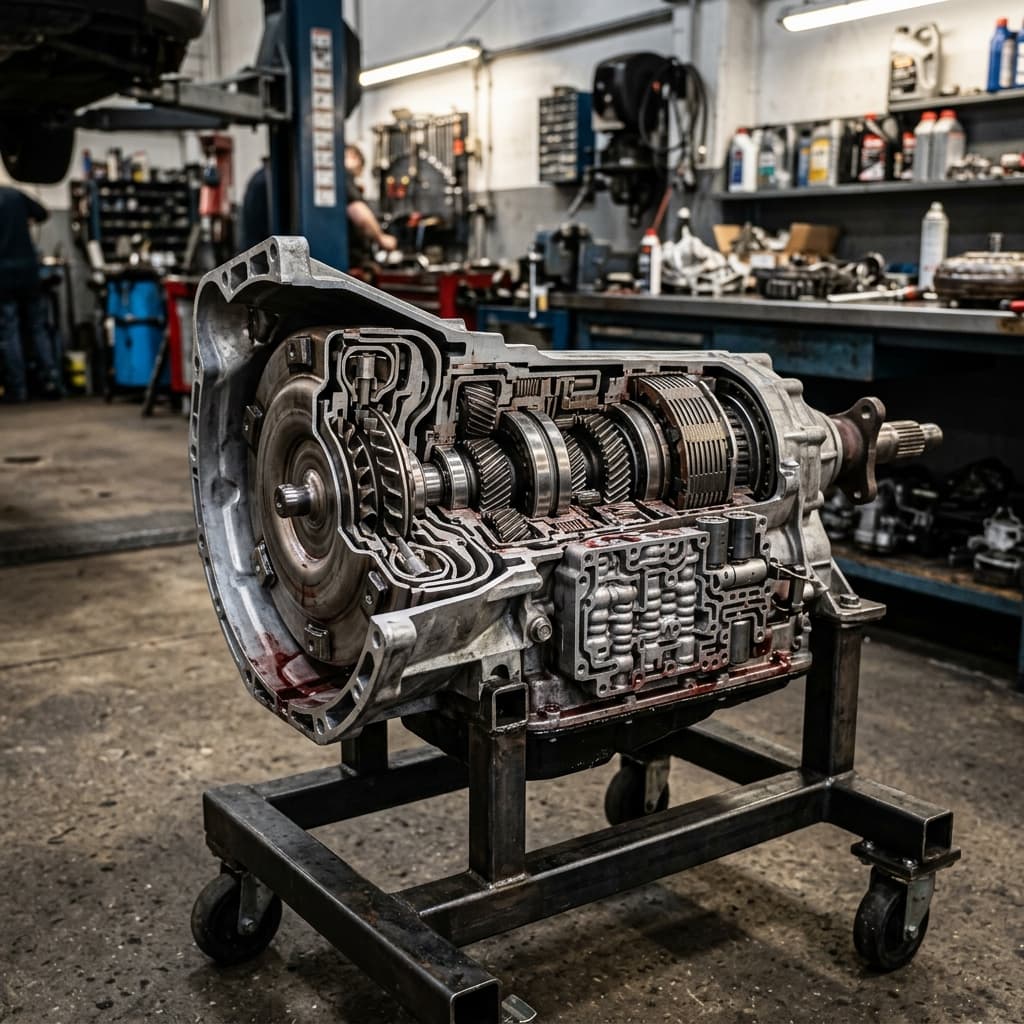
Your transmission is one of the most important — and most expensive — systems in your vehicle. It sits between your engine and your wheels, and without it, your engine's power has no way to reach the road. Yet most drivers couldn't explain what a transmission actually does beyond "it makes the car go." This guide fixes that.
What a Transmission Does — The Simple Analogy
Think of your engine like a bicycle rider's legs. Your legs only produce power efficiently within a certain pedaling speed. If you tried to pedal in a gear that's too high at a dead stop, you'd stall. If you pedaled full speed in a gear too low at highway speed, your legs would be spinning uselessly.
A bicycle's gearbox solves this by matching your pedaling effort to whatever the terrain demands. Low gear for climbing hills, high gear for cruising flats. Your car's transmission does exactly the same thing — it matches the engine's power output to the driving conditions, whether you're inching through a parking lot, accelerating onto a highway, or cruising at a steady 65 mph.
Without a transmission, your engine could only drive the wheels at one fixed speed — either useful at 30 mph or useful at 70 mph, but never both. The transmission gives you the full range.
Automatic vs. Manual vs. CVT vs. Dual-Clutch
Modern vehicles come with four main transmission types, each with real trade-offs:
Automatic Transmission
The most common type in the U.S. Shifts happen automatically through a combination of hydraulics, electronics, and mechanical components. Pros: Easy to drive, smooth power delivery, good durability when maintained. Cons: Traditionally less fuel-efficient than manuals (though modern 8–10 speed automatics have largely eliminated this gap), more complex and expensive to repair.
Manual Transmission
The driver selects gears using a clutch pedal and shift lever. Pros: Simpler mechanically, typically cheaper to repair, gives the driver full control, and can be more fun to drive. Cons: Requires a learning curve, more physically demanding in heavy traffic, becoming less common as manufacturer support fades.
CVT (Continuously Variable Transmission)
Instead of fixed gears, a CVT uses a belt or chain running between two variable-diameter pulleys, creating a theoretically infinite range of ratios. Pros: Exceptional fuel economy, smooth acceleration without shift shock. Cons: Can feel disconnected (the "rubber band" sensation), less engaging to drive, and CVT repairs are often expensive — sometimes requiring full replacement.
Dual-Clutch Transmission (DCT)
A DCT uses two separate clutch packs — one for odd-numbered gears, one for even — pre-selecting the next gear before the shift actually happens. Pros: Lightning-fast shifts, efficiency close to a manual. Cons: Can feel jerky at low speeds, more complex than a traditional automatic, and repairs can be costly. Common in performance vehicles and some European brands.
How an Automatic Transmission Works — Simply Explained
An automatic transmission has two main mechanical systems working together:
The Torque Converter replaces the clutch pedal. It's a fluid coupling that sits between the engine and transmission. At idle, it allows the engine to spin while the car stays still. As engine speed increases, hydraulic fluid inside the converter transfers rotational force to the transmission input shaft. A lockup clutch engages at highway speeds to create a direct mechanical connection, improving efficiency.
Planetary Gear Sets are stacked sets of gears (a sun gear, planet gears, and a ring gear) that can produce different ratios depending on which element is held stationary and which is driven. By using hydraulic bands and clutch packs to hold or release specific gears, the transmission's computer (the TCM) selects the ideal ratio for the current speed and throttle position — automatically, dozens of times on every drive.
Signs Your Transmission Is in Trouble
Transmissions rarely fail all at once. They give warnings. Watch for:
1. Slipping
The engine revs higher than expected without a corresponding increase in vehicle speed. It feels like the car is briefly in neutral before catching again. This is a classic sign of worn clutch packs or low fluid.
2. Delayed Engagement
You shift from Park to Drive, and there's a noticeable pause — sometimes a full second or two — before the transmission actually engages. Healthy transmissions engage almost immediately.
3. Harsh or Erratic Shifting
Shifts that feel like a thud or clunk instead of smooth transitions, or a transmission that hunts back and forth between gears on flat ground, indicate either fluid degradation or internal wear.
4. Strange Noises
Whining, humming, or clunking from the transmission area is never normal. A whining noise often points to a failing torque converter or low fluid. Grinding on a manual suggests worn synchronizers.
5. Burning Smell
A sweet burning smell, especially if you've been driving hard or towing, often indicates overheated transmission fluid. Overheated fluid breaks down and loses its ability to lubricate and cool — accelerating internal damage.
6. Fluid Leak
Transmission fluid is typically bright red when new, darkening to a brownish-red as it ages. A puddle of red or dark fluid under the center of your vehicle is a leak that needs immediate attention. Running low on transmission fluid is one of the fastest ways to destroy a transmission.
7. Warning Light
The check engine light or a dedicated transmission warning light may illuminate. A transmission-related code (P07xx series) is worth diagnosing before the problem worsens.
Transmission Fluid — Why It Matters and What Color Means What
Transmission fluid does triple duty: it lubricates, cools, and provides hydraulic pressure to operate the clutch packs and bands. Degraded fluid causes all three functions to suffer.
- Bright red / cherry red: New or recently changed. Healthy.
- Dark red / medium brown: Used but still serviceable. May be approaching change interval.
- Dark brown / very dark: Oxidized and degraded. Change due or overdue.
- Black with burnt smell: Severely overheated or contaminated. Change immediately and inspect for internal damage.
- Pink and milky: Coolant has mixed with the fluid — serious problem requiring immediate diagnosis (often a failed transmission cooler in the radiator).
Change intervals vary widely: every 30,000 miles for vehicles that see severe service (towing, stop-and-go, extreme temperatures) to 60,000–100,000 miles for normal use. Many manufacturers specify "lifetime" fluid, but most transmission specialists recommend changing it regardless — especially on vehicles you plan to keep past 100,000 miles.
Transmission Flush vs. Drain and Fill — Which Is Right?
This is one of the most debated topics in transmission service:
Drain and Fill: Removes 30–50% of the old fluid (whatever drains by gravity) and replaces it with fresh fluid. Gentle, widely accepted as safe for any transmission. Recommended for routine maintenance on a consistent schedule.
Transmission Flush: Uses a machine to exchange nearly 100% of the fluid, sometimes with a cleaning solvent. Gets more old fluid out, but on a high-mileage or neglected transmission, dislodging accumulated debris can occasionally cause problems.
General guidance: If you've been keeping up with fluid changes, a flush is fine. If the transmission has never been serviced and has 80,000+ miles, a drain and fill — possibly repeated twice over a few thousand miles — is the safer approach.
Repair vs. Replace — What Makes Sense?
When a transmission fails, you'll face three options:
- Repair (targeted fix): Works when the problem is isolated — a failed solenoid, a leaking seal, a single clutch pack. Cost: $300–$1,500 depending on the component.
- Rebuild: The transmission is disassembled, worn components are replaced, and it's reassembled. Typically costs $1,500–$3,500 for a professional shop rebuild. Good option when the core transmission case is sound.
- Replacement (reman or used unit): A remanufactured transmission is fully rebuilt to factory specs at an off-site facility. Cost: $2,500–$5,000 installed. A used unit from a salvage yard costs less but comes with unknown history.
When repair makes sense: When the failure is specific, well-diagnosed, and the rest of the transmission is in good shape.
When replacement makes sense: When internal damage is extensive, the rebuild cost approaches replacement cost, or the vehicle has been driven severely with degraded fluid for a long period.
On a high-mileage vehicle: The math matters. If your car is worth $5,000 and a transmission replacement costs $4,000, that's a tough call. But if you owe $0 on the car and it has a solid body and engine, a rebuild often still makes financial sense versus a car payment.
Frequently Asked Questions
How long do transmissions last?
A well-maintained automatic transmission typically lasts 150,000–200,000 miles. Manual transmissions often outlast automatics — 200,000+ miles is achievable with proper fluid changes and no aggressive clutch abuse. CVTs tend to have shorter lifespans, often 100,000–150,000 miles, and can be expensive to replace.
What does a slipping transmission feel like?
Slipping feels like the engine is revving freely — RPMs climb — without the car accelerating as expected. Some drivers describe it as a brief moment where the car seems to be in neutral. It may happen only occasionally at first, then become more frequent as the condition worsens.
Is it worth repairing a transmission on a high-mileage car?
It depends on the overall condition of the vehicle and the repair cost relative to the car's value. A vehicle with a solid body, good engine, and a $2,000 transmission repair can still be a much better value than a $30,000 car payment. Have a trusted technician evaluate the whole vehicle before deciding.
How much does a transmission replacement cost?
A remanufactured transmission installed typically costs $2,500–$5,000 for most common vehicles. Luxury and European vehicles can be significantly higher. A salvage yard unit is cheaper but riskier. A full professional rebuild typically runs $1,500–$3,500.
If you're hearing unfamiliar noises, feeling rough shifts, or seeing a warning light, don't wait. Chloe's Auto Repair & Tire has experienced transmission technicians at our locations in Woodstock, Marietta, Roswell, and Spring, TX. We'll diagnose the problem accurately before recommending a repair — no upselling, no guesswork.