
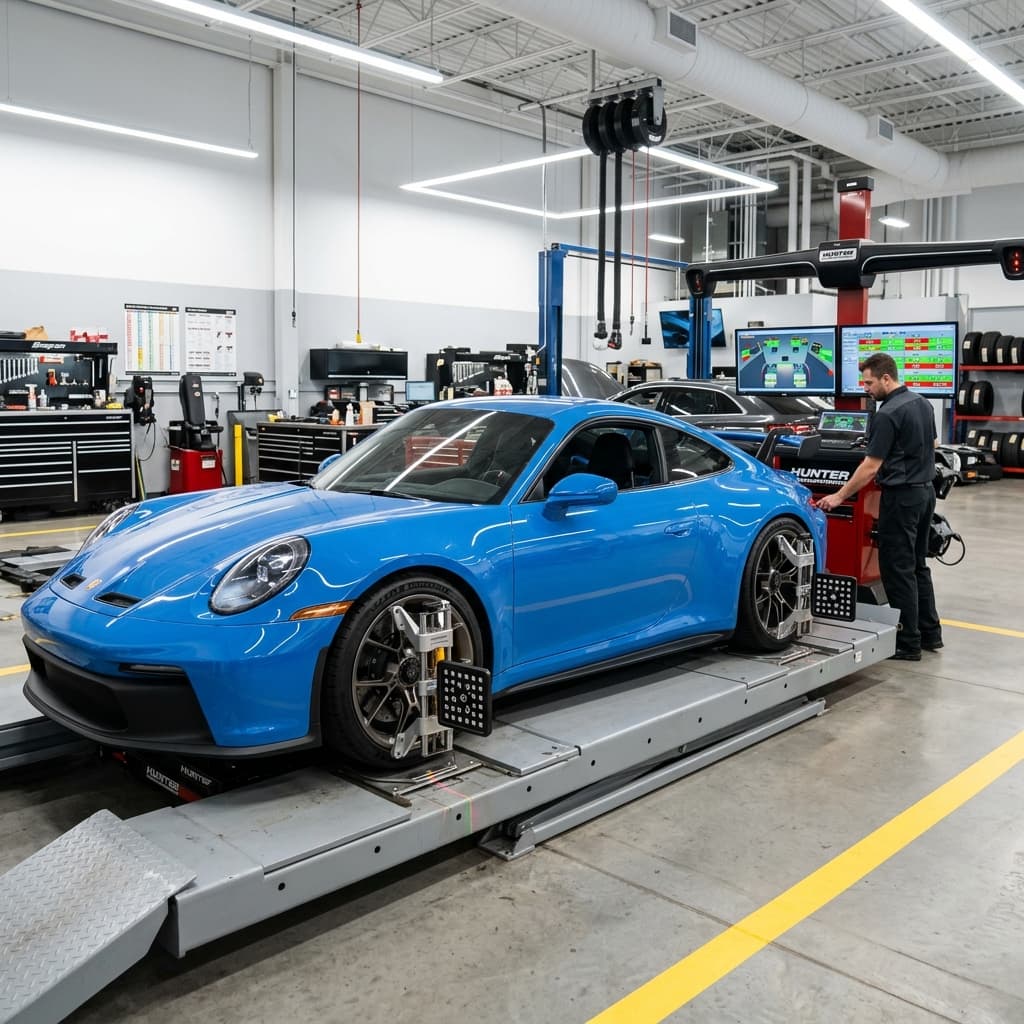
The straight answer: a 2-wheel (front) alignment costs $50–$100. A 4-wheel alignment costs $100–$175. Most modern cars need a 4-wheel alignment. Trucks with solid rear axles typically need only a front alignment. If a shop is quoting you significantly more than that without a good reason — like a vehicle that requires special adaptors or a heavily modified suspension — ask why.
Alignment isn't the most exciting maintenance topic, but it's one of the highest-ROI services on the board. A set of tires costs $600–$1,200. A misaligned vehicle can cut that tire life in half. A $100 alignment protecting a $1,000 tire set is about as straightforward as math gets.
What Does a Wheel Alignment Actually Do?
Your wheels need to point in a very specific direction relative to the road and to each other. Alignment is the process of measuring and adjusting the suspension geometry that controls those angles. There are three primary angles:
Camber is the inward or outward tilt of the tire when viewed from the front. Zero camber means the tire is perfectly vertical. Negative camber (top of tire leaned inward) is common on performance vehicles for cornering grip. Too much camber in either direction causes the inner or outer edge of the tire to wear faster than the rest of the tread.
Toe is whether the tires point inward (toe-in) or outward (toe-out) when viewed from above — like the difference between standing pigeon-toed versus duck-footed. Toe is the most critical angle for tire wear. Even a small toe error causes the tire to scrub sideways across the pavement with every rotation instead of rolling cleanly forward.
Caster is the forward or backward angle of the steering axis when viewed from the side. Caster primarily affects steering feel and straight-line stability rather than tire wear. Positive caster (the steering axis tilted toward the driver) gives the steering a self-centering tendency. Low caster makes a car feel vague and wandery.
These angles drift over time. Potholes, curb strikes, and worn suspension components all shift the geometry. It doesn't take a major impact — normal suspension wear over 50,000–75,000 miles is enough to move the angles meaningfully out of spec.
2-Wheel vs. 4-Wheel Alignment: Which Do You Need?
The answer depends on your vehicle's rear suspension design:
| Vehicle Type | Alignment Type Needed | Typical Cost |
|---|---|---|
| Older domestic cars and trucks with solid rear axles | Front (2-wheel) only | $50–$100 |
| Most cars and crossovers built in the last 15–20 years | 4-wheel | $100–$175 |
| AWD and 4WD vehicles | 4-wheel (always) | $100–$175 |
| Any vehicle with independent rear suspension | 4-wheel | $100–$175 |
| Lifted or lowered vehicles | 4-wheel (may need special adaptors) | $150–$250+ |
A solid rear axle is fixed — the rear wheels don't have adjustable geometry, so there's nothing to align back there. On modern vehicles with independent rear suspension, the rear wheels have camber and toe that can and do move out of spec, just like the front. If your car has IRS and you only do a front alignment, you're leaving half the job undone.
If you're not sure which type your vehicle has, ask — or we'll tell you when you bring it in.
Signs You Need an Alignment
Some alignment problems announce themselves clearly. Others are slow and silent until you notice a tire that's worn down to the cord on the inside edge.
The car pulls to one side. Let go of the wheel on a flat, straight road (briefly and safely). A properly aligned car tracks straight. If it drifts consistently left or right, alignment is the likely cause — though a low tire or a brake that's dragging can mimic this, so check tire pressure first.
The steering wheel is off-center when driving straight. If your steering wheel is turned 5–10 degrees to one side to keep the car going straight, the alignment is off. This is almost always a toe or caster issue.
Uneven tire wear. Wear on the inner or outer edge of a tire (camber or toe problem), feathering across the tread (toe problem), or dramatically faster wear on the front tires vs. the rear are all alignment signatures. If you're rotating tires every 6,000–7,500 miles and noticing unusual wear patterns, get an alignment check before the next rotation.
Steering wheel vibration. Alignment issues can cause vibration, though this overlaps with wheel balancing problems and worn suspension components. If the vibration is directional — worse when turning — alignment is more likely the cause.
The car feels loose, vague, or wanders. A car that requires constant small corrections to hold a lane, or that feels like it's floating rather than tracking precisely, often has a caster or toe issue.
One rule worth remembering: if you hit a curb or pothole hard enough to feel it in your teeth, get an alignment check. Don't wait for symptoms. The impact that's strong enough to bend a rim or pop a tire is absolutely strong enough to knock the suspension geometry out of spec. Catching it early costs $100. Replacing a tire destroyed by six months of bad alignment costs much more.
What's Included in an Alignment?
Here's the actual sequence of what happens when you bring a vehicle in for alignment:
1. Sensor targets go on each wheel. The vehicle is driven onto an alignment rack and sensor targets (reflective or camera-based, depending on the system) are mounted to each wheel hub. These targets let the alignment computer precisely measure the angle of every wheel.
2. The technician reads current angles. The system produces a live printout showing current camber, toe, and caster readings at all four corners against the manufacturer's specifications. You can see exactly how far out of spec each angle is — in decimal degrees.
3. Adjustments are made to adjustable components. Most vehicles have adjustable toe at the front and often at the rear. Camber may or may not be adjustable depending on the design — some vehicles require aftermarket adjustable components to correct camber beyond what the factory allows. The technician makes the adjustments to bring each angle into spec.
4. A final printout shows before and after. This is the document that tells you the job was actually done. The printout shows where each angle started and where it ended. At Chloe's, we hand you this printout — because a shop that did the work should be able to show it. If you go somewhere and don't get a before/after printout, ask for it. Every modern alignment machine produces one automatically.
The whole process typically takes 45 minutes to an hour on a straightforward vehicle. Vehicles with seized adjustment points, heavily corroded hardware, or aftermarket suspension can take longer.
You can book our alignment and tire service online or drop in — alignment is one of the fastest turnaround services we do.
How Often Do You Need an Alignment?
The general guideline is every 12,000–15,000 miles as preventive maintenance. But several situations require an alignment check regardless of mileage:
- After any significant impact — curb strikes, deep potholes, minor accidents. "Significant" means you felt it; if your passengers said "whoa," get an alignment check.
- After suspension or steering component replacement. Ball joints, tie rods, control arms, struts — replacing any of these changes the geometry. An alignment is not optional after suspension work; it's how the repair is completed correctly.
- When installing new tires. This is the highest-value moment for an alignment. You just paid for new tires — the worst thing you can do is put them on a misaligned car and watch them wear unevenly for the next 40,000 miles.
- When buying a used vehicle with unknown history. You have no idea what the previous owner hit, and worn suspension on a high-mileage vehicle is common. A pre-purchase alignment check is cheap insurance.
Does Alignment Affect Tire Life?
Yes — dramatically. Here's the specific math that makes this concrete:
A vehicle that's 0.17° out of toe spec (a very small deviation — well within what feels normal to drive) causes each tire to scrub 15 feet sideways for every mile traveled. That's not rolling wear; that's the tire being dragged laterally across the road surface.
Over 10,000 miles, that adds up to 28 miles of lateral scrubbing. Tire life is effectively cut in half on the affected axle. A set of tires that should last 50,000 miles starts looking like 25,000 miles — and the wear pattern is obvious once you know what to look for.
A $100–$175 alignment protecting a $600–$1,200 tire set is one of the clearest cost-benefit calculations in vehicle maintenance. There's no real argument for skipping it.
Alignment vs. Balancing: What's the Difference?
These two services are frequently confused because they're both wheel-related and often recommended together. They solve completely different problems.
Wheel balancing addresses weight distribution. When a tire and wheel assembly is mounted, the weight is never perfectly even around the circumference. Balancing machines spin the wheel and measure where the heavy spots are, then technicians add small lead or adhesive weights to counteract them. Imbalance causes vibration — specifically, a steering wheel or seat vibration that gets worse at higher speeds (typically 55–70 mph). Balancing does not change the direction the wheels point.
Wheel alignment addresses suspension geometry. It's about the angles at which the wheels contact the road — camber, toe, and caster. Misalignment causes pulling, off-center steering, uneven wear, and a wandering feel. It has nothing to do with vibration caused by weight imbalance.
You can have perfectly balanced wheels that are badly misaligned, and vice versa. They're separate measurements, separate procedures, and separate problems. When you get new tires, you typically want both — mounting and balancing as part of the tire installation, plus an alignment to make sure those new tires start their life pointed in the right direction.
Frequently Asked Questions
How long does a wheel alignment take?
For most vehicles, 45 minutes to an hour. Add time if the vehicle has seized adjustment hardware (common on older or high-mileage vehicles in salt-belt states), if it needs additional parts like adjustable camber bolts, or if it's a lifted truck with non-standard geometry. We'll give you a realistic time estimate when you bring it in.
Can I drive with bad alignment?
You can — the car won't stop running. But you're destroying your tires and possibly stressing steering components every mile you drive. There's no urgency-level danger (unlike a bad ball joint or failing brakes), but there's a real cost accumulating with every mile. If you notice pulling or off-center steering, get it in within the next few weeks, not the next few months.
Does alignment affect gas mileage?
Yes, measurably. Misaligned tires create rolling resistance because they're fighting the direction they're being dragged instead of rolling cleanly. Studies have shown fuel economy improvements of 0.5%–1% after alignment correction. It's not dramatic, but across 15,000 miles of driving, it adds up — and it's a bonus on top of the tire-life savings.
Should I get an alignment with new tires?
Yes, every time. This is the single most important moment to get an alignment — right before or right after new tires are installed. Putting new tires on a misaligned car is like buying new shoes and immediately wearing them down on one side. The tires start wearing unevenly from mile one. Most shops will offer a discounted alignment when combined with a tire installation. Take it.