
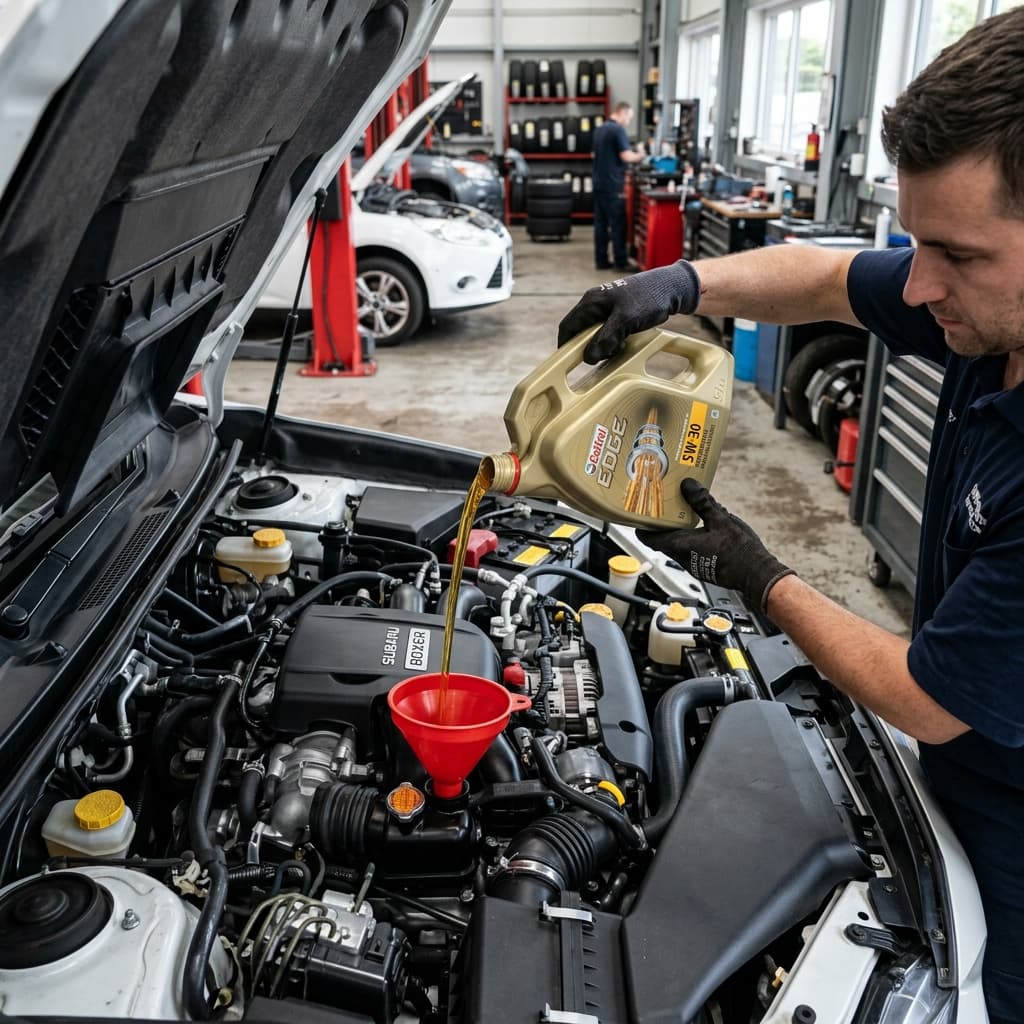
If you've ever been confused by the terms "oil change," "lube service," and "LOF" (lube, oil, and filter), you're not alone. These terms are often used interchangeably at shops and dealerships, but there are meaningful differences in what each service includes — and what you're paying for. Let's break it all down so you can make an informed decision the next time your vehicle is due.
Oil Change: The Basics
A standard oil change is straightforward: drain the old engine oil, replace the oil filter, and fill with fresh oil. That's it — no additional inspections, no chassis lubrication, no fluid top-offs. Quick oil change chains often provide exactly this basic service, get you in and out fast, and call it a day.
Lube Service: More Comprehensive
A "lube service" or "lubrication service" goes beyond the oil change to include lubricating chassis components — ball joints, tie rod ends, U-joints, control arm bushings, and other pivot points that need grease to move freely and resist wear. Historically, vehicles had dozens of grease fittings (called zerks) that needed regular attention.
Modern vehicles have fewer grease points, as many components now use sealed bearings that are lubricated for life. However, trucks, SUVs, 4x4s, and vehicles with heavy-duty suspension often still have serviceable grease fittings that benefit from regular lubrication — especially if you tow, haul, or drive on rough roads.
LOF: Lube, Oil, and Filter
The "LOF" combines both: an oil and filter change plus chassis lubrication. It's the classic full-service maintenance package and is considered a more thorough service than a simple oil change. When most full-service shops say "oil change," they actually mean an LOF — but it's always worth confirming what's included.
Oil Types Explained: Which One Does Your Car Need?
Not all engine oil is the same. The type of oil you use affects performance, protection, and how long you can go between changes:
- Conventional oil — Standard mineral-based oil refined from crude petroleum. Best for older vehicles or low-mileage engines with simple designs. Change interval: 3,000–5,000 miles. Cost: $35–$55 for a full service.
- Synthetic blend — A mix of conventional and synthetic base oils. Offers better protection than conventional at a moderate price increase. Good for SUVs, trucks, and drivers who occasionally tow or haul. Change interval: 5,000–7,500 miles. Cost: $45–$70.
- Full synthetic oil — Engineered molecules that provide superior protection against heat breakdown, sludge, and wear. Required by most newer vehicles. Change interval: 7,500–10,000 miles (some up to 15,000). Cost: $65–$95.
- High-mileage oil — Synthetic blend or full synthetic formulated with seal conditioners and extra additives for engines with 75,000+ miles. Helps reduce oil consumption and minor leaks. Cost: $55–$85.
Bottom line: Check your owner's manual. Using the manufacturer-recommended oil type isn't optional — it's essential for maintaining your warranty and protecting your engine.
What Actually Happens During an Oil Change? (Step by Step)
It's helpful to know what's happening under your vehicle so you can spot corners being cut:
- Vehicle is lifted on a hoist or driven onto ramps for access underneath.
- Drain plug is removed and old oil drains into a catch pan. A technician may note the oil's color and condition — dark, gritty, or metallic-flecked oil tells a story.
- Old oil filter is removed. Some oil will drain from the filter housing as well.
- Drain plug is reinstalled with a new crush washer (if applicable) and torqued to spec. Over-tightened drain plugs crack oil pans; under-tightened plugs leak.
- New oil filter is installed — the gasket is lubricated with fresh oil to ensure a proper seal.
- Fresh oil is poured in to the manufacturer-specified quantity and type.
- Engine is started briefly to circulate oil and check for leaks at the drain plug and filter.
- Oil level is verified on the dipstick and adjusted if needed.
Quick-Change Shops vs. Full-Service Shops: An Honest Comparison
Quick-change oil shops serve a purpose — they're fast and convenient. But there are trade-offs worth understanding:
- Speed vs. thoroughness: Quick-change shops prioritize volume. A 10-minute oil change doesn't leave time for a meaningful vehicle inspection.
- Upselling pressure: Many quick-change chains train employees to recommend additional services (transmission flushes, fuel system cleaners) that may not be necessary. A full-service shop recommends based on your vehicle's actual condition.
- Technician experience: Full-service shops employ experienced, often ASE-certified technicians who can spot developing problems. Quick-change shops frequently employ entry-level staff.
- Filter and oil quality: Some budget shops use the cheapest filters and oil available. A reputable full-service shop uses OEM-equivalent or better components.
Neither option is inherently "wrong" — but understanding the trade-offs helps you choose based on what matters to you.
Why Oil Filter Quality Matters
The oil filter isn't just a commodity part — a cheap filter can undermine an expensive oil change. Inside every oil filter is a pleated filtering media that traps contaminants. Here's what separates a quality filter from a bargain-bin one:
- Filtering media: Quality filters use synthetic or blended media that catches particles down to 20–25 microns. Cheap filters use basic cellulose that lets smaller particles through.
- Anti-drain-back valve: Prevents oil from draining out of the filter when the engine is off, eliminating that brief moment of dry startup. Cheap filters often have weak or missing valves.
- Bypass valve: Opens to allow unfiltered oil flow if the filter clogs — better than no oil at all. Quality filters calibrate this valve precisely.
At Chloe's, we use OEM-equivalent filters on every vehicle because the $5 saved on a cheap filter isn't worth the risk to a $5,000 engine.
What Does a Full-Service Oil Change Include at Chloe's?
At Chloe's Auto Repair & Tire, our oil change service goes well beyond the basics:
- Drain old oil and properly dispose of it
- Replace the oil filter with a quality OEM-equivalent filter
- Fill with manufacturer-specified oil (conventional, synthetic blend, or full synthetic)
- Lubricate chassis components as applicable
- Complimentary multi-point inspection — this is where we add real value
The Multi-Point Inspection: What We Actually Check (and Why)
Our complimentary inspection covers the systems most likely to develop problems between service visits:
- Fluid levels (transmission, brake, power steering, coolant, windshield washer) — Low brake fluid can indicate worn pads; low coolant can mean a developing leak.
- Tire condition and pressure — Uneven wear patterns reveal alignment or suspension issues before they become expensive.
- Brake pad thickness — Catching pads at 3mm saves you from rotor damage that doubles the repair cost.
- Belts and hoses — Cracked serpentine belts and swollen coolant hoses fail without warning, often leaving you stranded.
- Battery health — A quick voltage and load test predicts failure before you're stuck in a parking lot with a dead battery.
- Lights and wipers — Burned-out lights are a safety hazard and a ticket waiting to happen.
This inspection is the most valuable part of a routine oil change. It catches developing problems while they're still small and inexpensive to fix — and it's something most quick-change shops skip entirely.
How to Read Your Oil Change Sticker
That small sticker in the upper corner of your windshield contains important information:
- Date: When the oil change was performed
- Mileage at service: Your odometer reading at the time of service
- Next service due: The mileage or date for your next oil change — whichever comes first
- Oil type: The weight and type of oil used (e.g., 5W-30 Full Synthetic)
If you're unsure whether you're due, check the sticker — or just stop by any of our locations and we'll look it up in your service history.
Cost Breakdown: What You're Actually Paying For
When you pay for an oil change, here's where your money goes:
- Oil (4–8 quarts depending on your engine): $20–$60
- Oil filter: $5–$15
- Labor (20–45 minutes of technician time): $15–$35
- Disposal and environmental fees: $2–$5
- Multi-point inspection (at a full-service shop): Included at no extra charge
Full synthetic oil changes cost more because the oil itself is more expensive — not because the labor is harder. The longer interval between changes often makes synthetic oil less expensive per mile than conventional.
How Often Do You Need This Service?
Follow your manufacturer's recommended interval — typically every 5,000–7,500 miles for synthetic blend and 7,500–10,000 miles for full synthetic. Don't rely on the outdated "3,000-mile rule" unless your owner's manual specifically calls for it (most modern vehicles don't).
That said, severe driving conditions shorten the interval. If you frequently drive in stop-and-go traffic, extreme heat, dusty roads, or make lots of short trips where the engine never fully warms up, consider changing oil on the shorter end of the recommended range.
A Note on Proper Oil Disposal
Used motor oil is toxic and should never be poured down a drain, into the ground, or thrown in the trash. A single gallon of used oil can contaminate one million gallons of drinking water. When you have your oil changed at a professional shop like Chloe's, proper disposal is handled for you — we recycle all used oil and filters through licensed recycling programs.
Frequently Asked Questions
Is synthetic oil worth the extra cost?
For most modern vehicles, yes. Full synthetic oil resists heat breakdown better, flows more easily in cold starts, and lasts significantly longer than conventional oil. When you factor in the extended change interval (7,500–10,000 miles vs. 3,000–5,000), synthetic often costs less per mile. Plus, many newer engines are specifically designed for synthetic and require it to maintain warranty coverage.
Can I switch from conventional to synthetic oil?
Absolutely. Switching to synthetic oil is safe for any engine and can be done at any oil change — no flush or special procedure needed. The only caveat: on very high-mileage engines with existing minor leaks, synthetic oil's thinner viscosity at startup may make small seeps slightly more noticeable. In those cases, a high-mileage synthetic blend is often the best choice.
What happens if I go too long without an oil change?
Over time, oil breaks down and loses its ability to lubricate, cool, and clean. Neglected oil turns into thick sludge that clogs passages, starves bearings of lubrication, and causes accelerated wear. In severe cases, sludge buildup leads to oil starvation and catastrophic engine failure — a repair that can cost $4,000–$10,000+. A $65 oil change is cheap insurance.
Do I really need to change oil every 3,000 miles?
For most vehicles built after 2010, no. The 3,000-mile rule dates back to when conventional oil was the only option and engine tolerances were less precise. Modern engines with synthetic oil can safely go 7,500–10,000 miles. Always check your owner's manual — the manufacturer knows your engine best.
What's included in a full-service oil change?
A full-service oil change (sometimes called an LOF) includes draining old oil, replacing the filter, filling with fresh oil, lubricating chassis grease points, and performing a multi-point vehicle inspection. At Chloe's, we also check tire pressure, brake condition, battery health, all fluid levels, belts, hoses, lights, and wipers — all included in the price.
Whether you're due for a routine oil change or want a full-service inspection that catches small problems before they become expensive ones, Chloe's Auto Repair & Tire has you covered. Stop by any of our locations in Woodstock, Marietta, Roswell, or Spring, TX — no appointment needed for oil changes.