
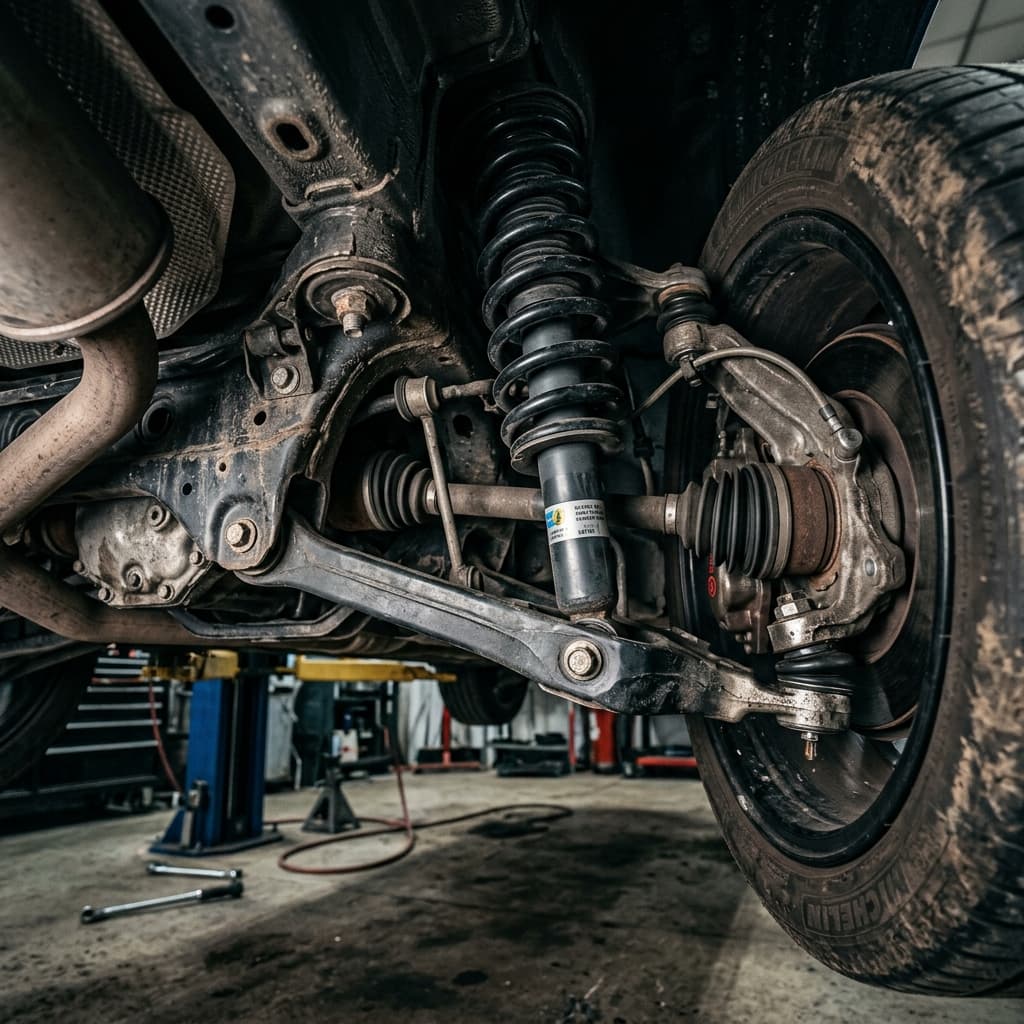
The suspension system acts as the link between your vehicle's body and its wheels. It absorbs road impact, maintains tire traction, and provides the stability you rely on for safe driving.
What Does a Car Suspension Do?
Your suspension system serves three essential functions:
- Absorbs road impacts: Cushions the cabin from bumps, potholes, and uneven road surfaces
- Maintains traction: Keeps tires in contact with the road, which is vital for handling, braking, and safety
- Provides stability: Helps the vehicle remain stable during cornering, acceleration, and braking
Key Suspension Components
Springs
The foundation of energy absorption. Springs support the vehicle's weight and compress to absorb energy from road irregularities. Most modern vehicles use coil springs, though some trucks use leaf springs.
Shock Absorbers (Dampers)
Shocks control the motion of the springs. Without them, a vehicle would bounce excessively after hitting a bump. They convert kinetic energy into heat through hydraulic or gas pressure.
Struts
Struts are a structural variation of a shock absorber that also supports the vehicle's weight. MacPherson struts, common in modern vehicles, combine a shock absorber and spring mount into a single unit.
Control Arms
Hinged metal arms that connect the wheel hub to the vehicle's frame, allowing wheels to move up and down while maintaining proper alignment.
Anti-Roll Bars (Sway Bars)
These connect suspension components on opposite sides to reduce body roll when cornering, improving stability and handling.
Ball Joints
Pivot points that connect control arms to steering knuckles, allowing flexible movement and steering control.
Shocks vs. Struts: What's the Difference?
Shock absorbers are standalone damping components. Struts are structural elements that integrate a shock absorber with a mount to support the vehicle's weight and often affect wheel alignment. Your vehicle uses one or the other — not both — at each wheel position.
Signs of Suspension Problems
- Excessive bouncing after bumps
- Nose-diving when braking
- Clunking or rattling over rough roads
- Uneven tire wear
- Vehicle pulling to one side
Because each part plays an essential role, maintaining your suspension in good condition is critical. Our steering and suspension repair service covers shocks, struts, control arms, ball joints, and sway bar links — book an inspection at any of our five locations.