
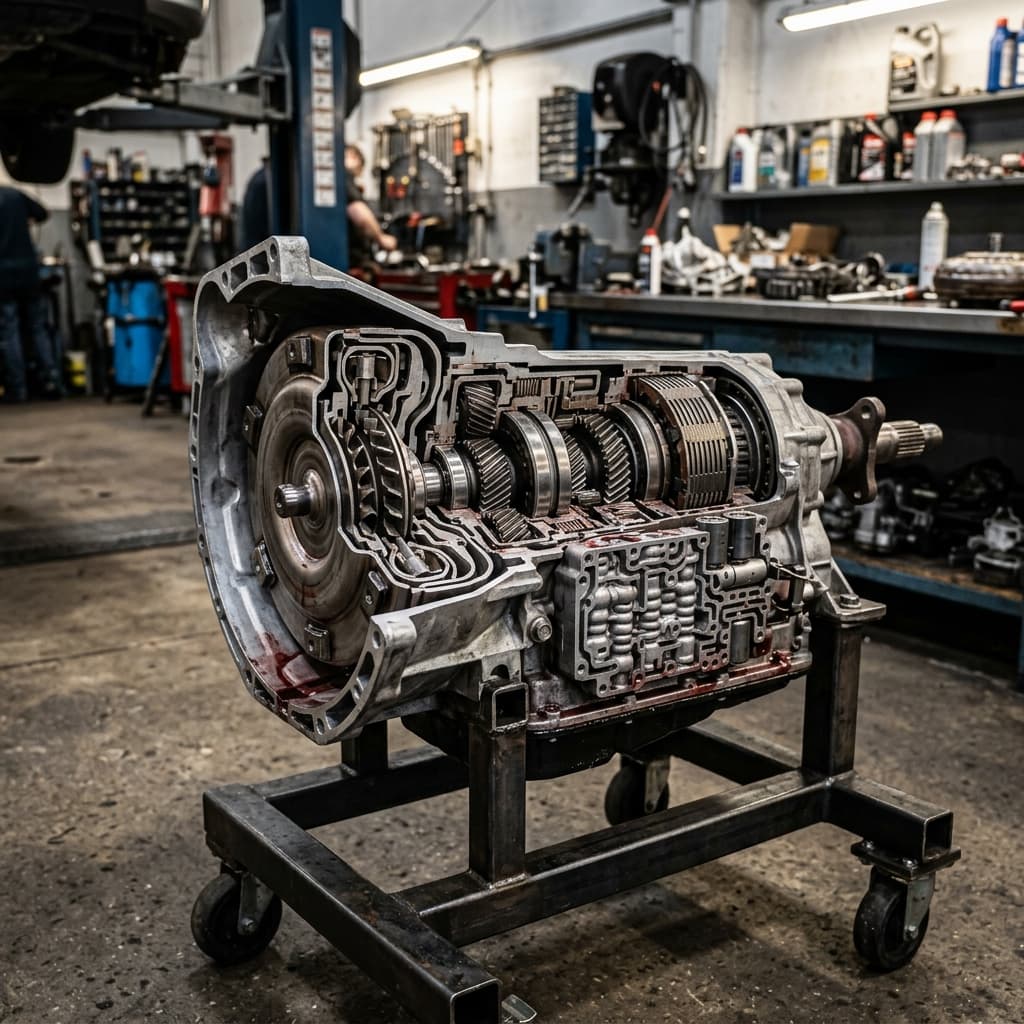
Your car's drivetrain is the system that transfers power from the engine to the wheels. It includes the transmission, driveshaft, differential, CV joints (on front-wheel and all-wheel drive vehicles), U-joints (on rear-wheel drive), and axle assemblies. When any of these components wear out, you'll feel it — and ignoring the symptoms almost always turns a moderate repair into an expensive one.
How Your Drivetrain Works
In a front-wheel drive (FWD) vehicle, power goes from the transmission through two CV axle shafts directly to the front wheels. In a rear-wheel drive (RWD) vehicle, a driveshaft carries power from the transmission to the rear differential, which splits it between the rear wheels. All-wheel drive (AWD) and 4x4 systems combine both, adding a transfer case that distributes power between front and rear axles. Every connection point — every joint, bearing, and seal — is a potential failure point.
The Most Common Drivetrain Problems
Clicking or Popping When Turning
This is the classic symptom of a worn CV joint. CV (constant velocity) joints allow the axle shafts to flex as you turn the steering wheel. Each CV joint is protected by a rubber boot filled with grease. When the boot tears, the grease slings out and dirt gets in, destroying the joint within a few thousand miles. A torn CV boot costs around $200 to replace — but if you ignore it, the joint itself fails, and you're looking at a $600+ CV axle replacement. We see this every week at our Georgia and Texas locations.
Vibration at Highway Speed
A vibration that gets worse as you accelerate — especially between 45–65 mph — often points to a worn U-joint or an out-of-balance driveshaft. U-joints are the pivot points on a rear-wheel drive driveshaft. They wear gradually, and when they develop play, the driveshaft can't spin smoothly. A worn U-joint that snaps at highway speed can send the driveshaft into the pavement — a dangerous and expensive failure that's entirely preventable with a $50–$150 U-joint replacement.
Clunking When Shifting from Park to Drive
A heavy "clunk" when you shift from park to drive (or drive to reverse) usually indicates excessive play in the drivetrain — worn U-joints, a worn differential, or worn transmission mount. Some play is normal, but a pronounced clunk that you can feel through the floorboard means something has worn beyond its service limit.
Whining Noise from the Rear
A whining or humming noise that changes with vehicle speed (not engine speed) typically points to a worn ring and pinion gear set or failing bearings inside the rear differential. Differential fluid condition matters enormously here — neglected fluid accelerates gear and bearing wear, turning a $200 fluid service into a $1,500+ differential rebuild.
Differential Fluid: The Maintenance Most People Skip
Most manufacturers recommend changing differential fluid every 30,000 to 60,000 miles, yet it's one of the most commonly skipped services. Differential fluid lubricates the ring and pinion gears and the bearings that support them. As it breaks down, it loses its ability to protect these precision-machined surfaces. Vehicles used for towing, off-roading, or frequent stop-and-go driving need it changed more often. At Chloe's Auto Repair & Tire, our drivetrain service includes differential fluid condition checks during any inspection.
When to See a Mechanic
- Clicking when turning — CV joint wear, address within 1–2 weeks
- Vibration at highway speed — U-joint or driveshaft, get it checked soon
- Clunking when shifting gears — drivetrain play, schedule an inspection
- Fluid leak under the center of the vehicle — differential or transmission seal
- Whining from the rear — differential wear, don't delay
Drivetrain problems are one of those areas where early diagnosis saves serious money. A digital inspection showing exactly what's worn lets you plan repairs before a minor issue cascades. Visit any of our five locations for a thorough drivetrain evaluation, and if you're experiencing shifting issues specifically, check out our transmission service page.
Frequently Asked Questions
What's the difference between a CV joint and a CV axle?
A CV (constant velocity) joint is the flexible coupling at each end of a CV axle. The CV axle is the entire shaft assembly — inner joint, outer joint, shaft, and protective boots. When a CV joint fails, we typically replace the entire axle assembly because it's more cost-effective and reliable than rebuilding individual joints. Quality replacement axle assemblies come pre-greased and pre-booted.
Do all vehicles have differentials?
Yes — every vehicle with more than one driven wheel has at least one differential. Front-wheel drive vehicles have a differential built into the transaxle. Rear-wheel drive vehicles have a separate rear differential. AWD and 4x4 vehicles have two differentials plus a transfer case. Each one needs periodic fluid service.
How do I know if my drivetrain issue is serious?
As a general rule: noises that change with vehicle speed (not engine RPM) are drivetrain-related and should be checked soon. Any vibration that gets worse over time is progressive wear — it won't fix itself. And fluid leaks from the center or rear of the vehicle should be addressed before the component runs dry. The sooner you catch drivetrain problems, the less they cost to fix.