
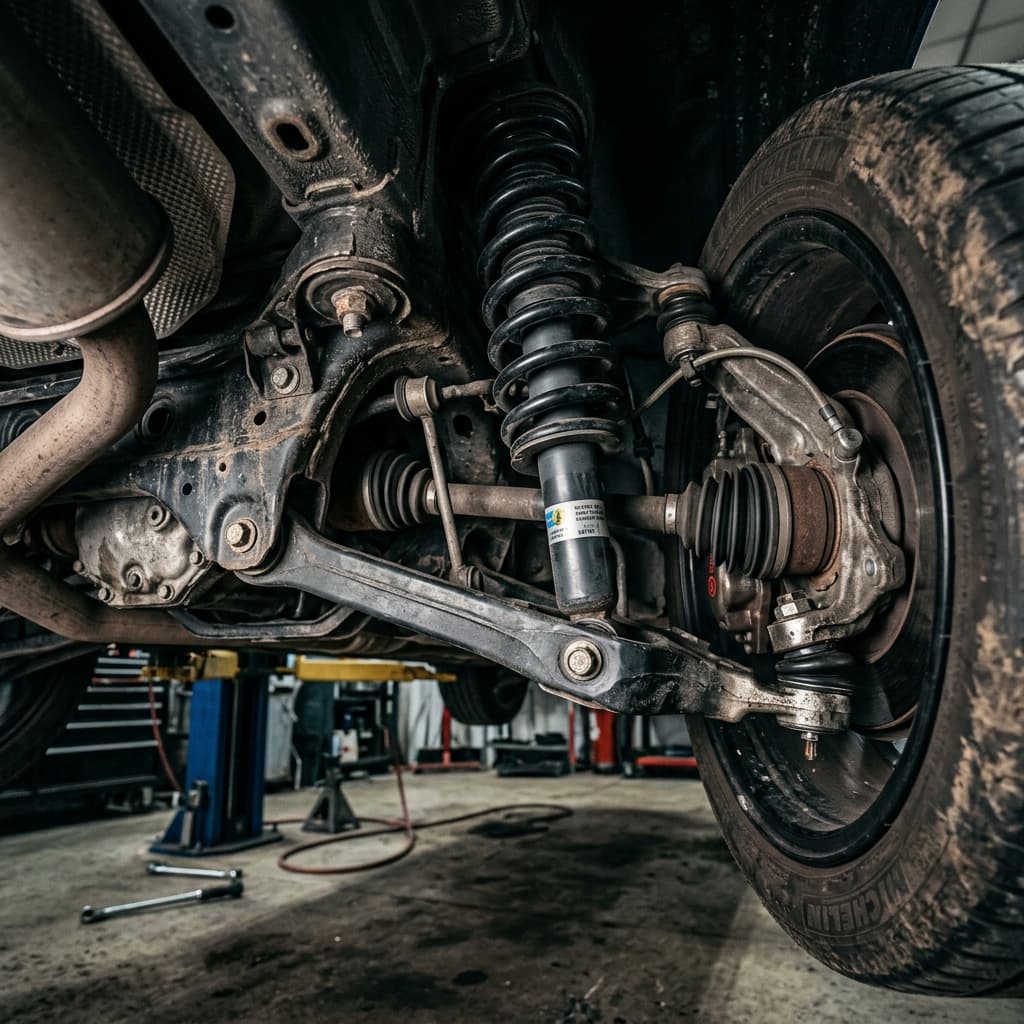
Most drivers think of suspension as a comfort feature — the thing that smooths out potholes and keeps the ride from feeling like a gravel road. That's only part of the story. Your suspension system is what keeps your tires in contact with the road. When it's failing, your stopping distance increases, your ability to steer in an emergency degrades, and tires wear unevenly. A car with shot shocks can take up to 20% longer to stop from 60 mph — that's the difference between avoiding an accident and not.
Knowing how to tell if your suspension is bad could save your tires, your alignment, and in the worst cases, your life. Here are the eight symptoms to watch for, how to test it yourself, and what you're looking at for repairs.
The 8 Warning Signs of Bad Suspension
1. Excessive Bouncing After Bumps
Healthy shocks and struts dampen the spring's oscillation after a bump — your car should settle almost immediately. If the front or rear keeps bouncing two, three, or four times after hitting a dip, your shocks or struts have lost their damping ability. This is the single most telling sign of worn-out dampers.
Quick test: Push down hard on one corner of the car and let go. If it bounces more than once or twice before settling, that corner's shock or strut is worn. Do all four corners. This is the classic bounce test — see the full procedure below.
2. Nose-Diving When Braking
Under hard braking, does the front of the car dip aggressively while the rear lifts? That's called brake dive, and it's a hallmark of failed front struts. The struts are supposed to resist that forward weight transfer. When they can't, your braking distance gets longer because the rear tires unload and lose grip — exactly when you need all four tires biting.
3. Pulling or Drifting to One Side
If the car drifts to one side without input, most people blame alignment — and that's often right. But suspension component failure causes misalignment. A worn ball joint, a cracked control arm bushing, or a collapsed spring can pull a wheel out of spec and make the car track crooked. Alignment can't fix a mechanical problem; it's a measurement, not a repair.
4. Steering Wheel Vibration
Vibration in the steering wheel at highway speed usually starts with tires (balance or wear), but worn tie rod ends, loose wheel bearings, and degraded struts can all transmit road vibration straight to your hands. If the vibration started after hitting a curb or pothole, suspect a bent wheel or damaged tie rod end specifically.
5. Uneven Tire Wear
Cupping (scalloped wear around the tread), feathering, or wear on the inner or outer edge of a tire are all signals that something in the suspension geometry is off. Cupping in particular is almost always caused by worn shocks or struts — the tire is literally bouncing off the road surface instead of maintaining constant contact. You can have perfect alignment and new tires, but if the shocks are bad, those tires will still wear unevenly.
6. Clunking or Knocking Over Bumps
A clunk from the front suspension over bumps, turning, or on uneven pavement usually comes from one of three places: worn control arm bushings that have lost their rubber cushion, a loose or broken sway bar end link, or a ball joint with excessive play. These noises tend to get louder and more frequent over time. A clunk that sounds metallic and sharp is more urgent than a dull thud — metallic means metal-on-metal contact with no rubber cushion remaining.
7. Leaking Shocks or Struts
Look at the strut body itself — the cylindrical tube you can usually see behind the wheel. If you see an oily film, a greasy streak, or actual drips running down the outside of the strut, the internal seal has failed. The shock is losing the hydraulic fluid it needs to dampen movement. A slightly damp strut might have some life left; a visibly wet or dripping strut is already compromised.
8. Car Sitting Lower on One Corner
If one corner of the car sits noticeably lower than the others when parked on level ground, a coil spring has either broken or lost enough tension that it can no longer support the vehicle's weight. A broken spring is usually accompanied by a harsh clunking noise on that corner, and the situation can worsen quickly — a fully collapsed spring can contact the wheel or limit suspension travel entirely.
The Bounce Test: 30-Second DIY Suspension Check
You don't need a lift or any tools for this one. Here's how to do it:
- Park on level pavement — a sloped driveway will give you misleading results.
- Push down firmly on one corner of the car (front or rear, driver or passenger side) using your full body weight. You want to compress the suspension as far as it will go.
- Release suddenly and count the bounces.
- 1–2 bounces and stops: Shocks/struts are working. This is normal.
- 3+ bounces or continues rocking: That damper is worn and needs replacement.
- Repeat all four corners. A car can have one good corner and three bad ones — test each.
If one corner bounces more than the others, that's your problem corner. If all four fail, you're overdue for a full suspension service.
Note: This test works well for basic damper assessment, but it won't catch worn bushings, ball joints, or tie rod ends. Those require a proper suspension inspection on a lift where a technician can check for play by hand.
Suspension Noises and What They Mean
| Noise | When It Happens | Likely Cause |
|---|---|---|
| Clunk | Bumps, turning, acceleration/deceleration | Worn control arm bushing, broken sway bar end link, loose ball joint |
| Squeak | Slow speeds, turning, going over speed bumps | Dry ball joint, worn strut mount bearing, degraded rubber bushing |
| Rattle | Highway speeds or rough roads | Loose sway bar link, broken spring isolator, loose heat shield |
| Groan | Turning at low speed (parking lots) | Worn steering rack, low power steering fluid, dry ball joint |
| Thud | Single hard bump | Bottomed-out strut (worn or collapsed), broken spring |
One rule of thumb: if a noise is there at slow speed and goes away on the highway, it's usually suspension. If it gets worse on the highway, it's often tires or wheel bearings.
How Bad Suspension Affects Braking Distance
This is the safety case people don't hear often enough. Your braking system can only work with the traction your tires provide. Tires can only provide traction if they're in contact with the road. Worn shocks and struts reduce that contact.
A study by the Monroe Institute found that vehicles with worn shock absorbers traveling at 60 mph can require up to 21 additional feet to stop compared to vehicles with new shocks — nearly two car lengths. That gap is the difference in a real-world emergency stop.
Add in brake dive (the front end dipping and rear unloading) from failed struts, and wet or slippery roads, and the stopping distance gap gets even worse. Suspension isn't separate from your safety systems — it's a load-bearing part of them.
Common Suspension Repairs and Typical Costs
These are real-world ranges based on typical labor rates and parts for most domestic and import vehicles. Luxury vehicles and some trucks run higher.
| Repair | Typical Cost Range | Notes |
|---|---|---|
| Shocks or struts (per axle) | $250–$700 | Always replace in pairs on the same axle |
| Ball joint (per joint) | $200–$400 | Upper and lower are separate; labor varies by design |
| Control arm | $300–$600 | Some designs include the ball joint; confirm what's included |
| Sway bar end links | $100–$200 | Often replaced in pairs; quick job |
| Tie rod end (per side) | $150–$350 | Requires alignment after replacement |
| Wheel bearing (per side) | $250–$500 | Hub-style bearings are faster; press-fit bearings cost more labor |
One note on struts specifically: always replace in axle pairs. Replacing only one strut creates an imbalance — the new side will handle differently than the worn side, which can make the car unpredictable in emergency maneuvers. The same goes for shocks on the rear axle.
After any suspension work that changes geometry (ball joints, control arms, tie rods, struts), alignment is required. Don't skip it — it's not upselling, it's how suspension repairs are completed correctly.
How Long Do Suspension Components Last?
There's no single answer because wear depends heavily on road conditions, driving style, and vehicle weight. Here are general guidelines:
- Shocks and struts: 50,000–100,000 miles under normal conditions. Rough roads, heavy payloads, or frequent off-road use cut that significantly.
- Control arm bushings: 80,000–100,000 miles, though salt-belt states see faster deterioration due to rubber degradation from road chemicals.
- Ball joints: 70,000–150,000 miles depending on design and whether the joint is loaded or non-loaded. Some sealed joints last the life of the vehicle; others wear faster.
- Sway bar links: 50,000–100,000 miles. These are small and inexpensive — they're often the first thing that starts clunking.
- Tie rod ends: 70,000–100,000 miles. Worn tie rods affect steering precision and tire wear, so don't delay replacement.
- Wheel bearings: 85,000–100,000 miles under normal conditions. Potholes and curb strikes can end a wheel bearing's life much sooner.
If you're buying a used vehicle with over 80,000 miles, a suspension inspection should be on your pre-purchase checklist. Worn suspension components are common on high-mileage cars and trucks, and the previous owner may not have known — or may not have disclosed — the condition.
Frequently Asked Questions
Is it safe to drive with bad suspension?
Depends on what's failed. Worn shocks and struts degrade handling and braking but won't cause immediate loss of control — you can get to a shop, but you shouldn't drive indefinitely on them. A broken spring or a severely worn ball joint is different. A spring that's come apart can puncture a tire. A ball joint with significant play can separate completely, dropping the wheel inward and causing loss of steering control at any speed. If you have a clunk and the car pulls aggressively to one side, get it inspected before your next highway trip.
How long can I drive on bad struts?
There's no clean answer, but the practical one is: not long without consequences. Bad struts accelerate tire wear, can damage strut mounts and upper bearings over time, and put more stress on other suspension components. If the bounce test shows obvious failure, schedule service within the next 1,000–2,000 miles at most. If you're already seeing cupped tire wear or steering wander, sooner.
What does bad suspension sound like?
The most common sound is a clunk or knock over bumps, especially from the front end. Sway bar end links and worn bushings are the most frequent culprits. A squeaking sound on slow turns or in parking lots usually points to a dry ball joint or worn strut mount. A groaning sound during low-speed maneuvers is often the steering rack or ball joints. If the noise changes character when you turn left vs. right, that helps narrow it to a specific side.
Does bad suspension cause tire wear?
Yes — it's one of the most common causes of premature and uneven tire wear. Worn shocks cause cupping (scalloped wear). Failed ball joints or control arm bushings pull the wheel out of camber alignment, causing inner or outer edge wear. Worn tie rods affect toe angle, causing feathering. You can spend $1,200 on new tires, but they'll wear out fast if the underlying suspension problem isn't fixed first.
If you're noticing any of these symptoms — noise, bouncing, pulling, uneven wear — our steering and suspension service page covers exactly what we inspect and repair. Chloe's Auto Repair & Tire serves North Metro Atlanta from five locations: Roswell, Woodstock, Holly Springs, Canton, and Jasper. Drop in or schedule an appointment and we'll put it on the lift and tell you exactly what's going on.