
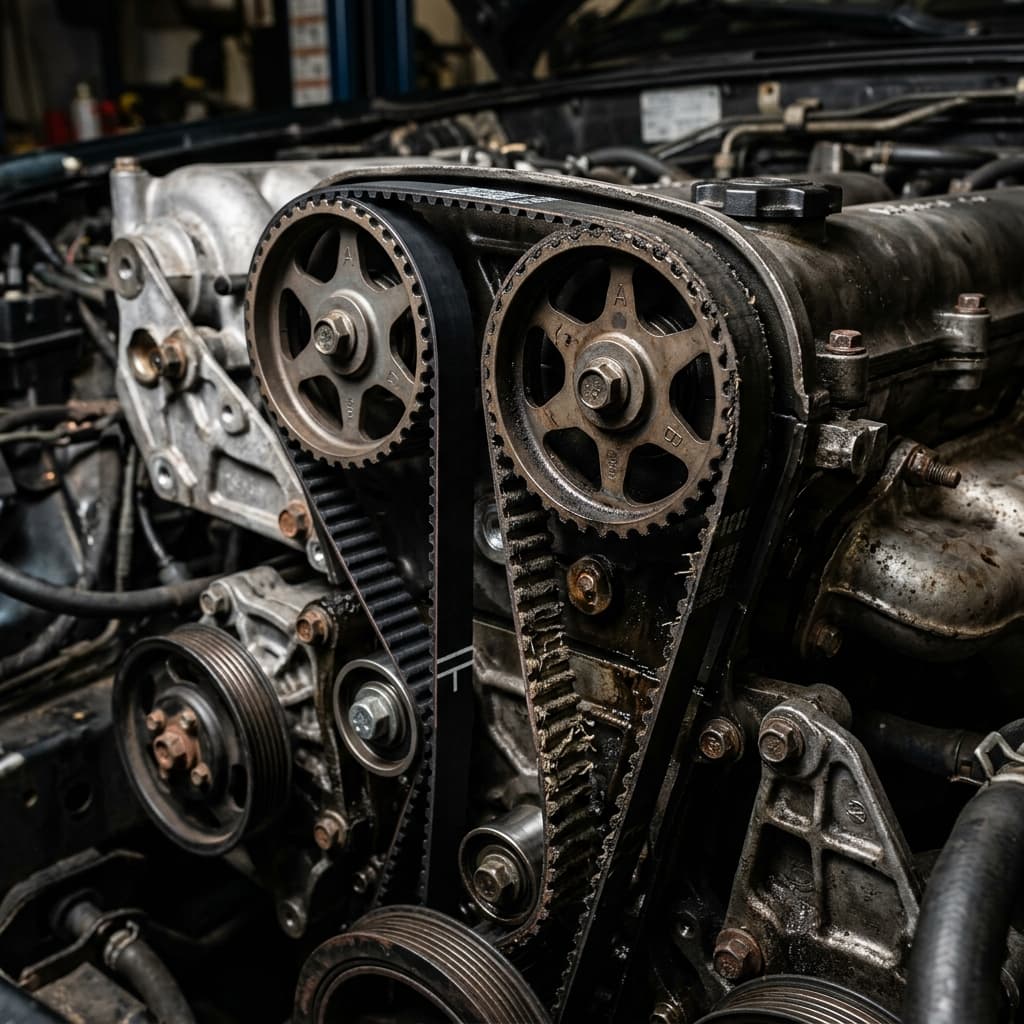
Most timing belts last 60,000 to 100,000 miles, depending on the manufacturer and engine. Unlike most wear items, timing belts don't gradually degrade — they work fine until they suddenly break. On interference engines, a broken timing belt can destroy the engine in seconds. Replace yours at or before the manufacturer's recommended interval, regardless of how it looks.
The timing belt is one of the most critical — and most overlooked — components in your engine. It synchronizes the rotation of the crankshaft and camshaft(s), ensuring valves open and close at precisely the right moments. Here are the 3 signs yours needs replacement — and everything else you need to know before your next service.
What Does the Timing Belt Do?
Your engine is a precisely choreographed machine. The crankshaft converts piston movement into rotation. The camshaft(s) open and close the intake and exhaust valves at exact moments in the combustion cycle. The timing belt connects these two shafts and keeps them synchronized. If the belt slips, stretches, or breaks, that synchronization is lost — and the consequences range from rough running to catastrophic engine destruction, depending on your engine type.
Unlike the serpentine belt (which drives accessories like the alternator and AC compressor on the outside of the engine), the timing belt is typically hidden inside a plastic timing cover on the front of the engine. You usually can't see it without removing that cover, which is part of why it's so often ignored.
Timing Belt vs. Timing Chain — Which Does My Car Have?
Not all vehicles use a timing belt. Many modern engines use a timing chain, which is a metal roller chain similar to a bicycle chain. Chains are designed to last the life of the engine and don't have scheduled replacement intervals. If your vehicle has a timing chain, this article doesn't apply to you — though chains can still fail if oil maintenance is neglected.
Timing belts are made of reinforced rubber and are more common on older vehicles and many import brands. Check your owner's manual or ask your mechanic if you're unsure which your vehicle has.
How Long Does a Timing Belt Last?
Most timing belts are rated for 60,000 to 100,000 miles, depending on the manufacturer and engine. Check your owner's manual for your specific interval — Honda, Toyota, and Subaru models often have different schedules. Age matters too: even a low-mileage vehicle should have its timing belt replaced after 7–10 years, because rubber degrades over time regardless of use.
Sign #1: You're at or Past the Recommended Mileage (or Time)
If your vehicle has 60,000+ miles and you don't know when the timing belt was last replaced, you're potentially driving on borrowed time. Check your owner's manual for the specific replacement interval. This isn't a "wait and see" situation — a timing belt doesn't send warning signals before it fails. If you're past the interval, schedule the replacement now.
Sign #2: Visual Wear Signs
If your timing belt is accessible for inspection (some are easier to see than others without removing the cover), look for:
- Cracks or fraying on the belt surface or edges
- Missing or damaged teeth — the belt drives via teeth that mesh with sprockets
- Glazing (shiny, polished appearance indicating slipping against the sprockets)
- Oil contamination — oil leaks from a cam seal or crank seal onto the belt dramatically shorten its life
Even if the belt looks okay, rubber compounds degrade internally before showing external cracking. Visual inspection is a supplement to the mileage interval, not a replacement for it.
Sign #3: Engine Performance Symptoms
A timing belt that has stretched or jumped a tooth can cause:
- Engine misfires or rough, uneven running
- Difficulty starting (especially when the engine is cold)
- Unusual ticking or clicking from the engine (the belt slapping inside the cover)
- Check engine light with cam/crankshaft correlation codes (P0016, P0017, P0018, P0019)
- Reduced power or fuel economy as combustion timing drifts
These symptoms can also point to other issues — but if your mileage is in the replacement range and you're seeing them, the timing belt should be the first thing investigated.
Interference vs. Non-Interference Engines: Why It Matters
This is the critical distinction that determines whether a broken timing belt is an inconvenience or a catastrophe:
Interference engine: The pistons and valves occupy overlapping space in the cylinder. The timing belt is the only thing that prevents them from colliding. When the belt breaks at speed, the pistons smash into the open valves — bending or breaking them, potentially cracking the cylinder head, and sometimes punching through the pistons themselves. Total engine replacement can cost $3,000–$8,000+.
Non-interference engine: The valves and pistons have enough clearance that they'll never collide. A broken belt means the engine stops suddenly — but no internal damage occurs. You'll need a tow and a new belt, but the engine survives.
Many popular vehicles — including many Honda, Acura, Volkswagen, Audi, Subaru, and some Toyota models — have interference engines. If your vehicle has an interference engine, a neglected timing belt is an existential threat to your engine. The cost of replacement ($400–$1,000) versus the cost of engine damage ($3,000–$8,000+) makes this one of the best returns on investment in auto maintenance.
What's Included in a Timing Belt Job?
Because the timing cover has to come off anyway, a quality timing belt replacement typically includes:
- The timing belt itself (obvious, but confirm it's a quality OEM or OEM-equivalent belt)
- Timing belt tensioner (a spring-loaded pulley that keeps the belt under proper tension — fails at similar intervals)
- Idler pulleys (guide the belt's path — cheap insurance)
- Water pump (on many engines, the water pump is driven by the timing belt. Since labor to access it is the same, replacing it simultaneously is almost always recommended. A failed water pump on an interference engine while waiting for the next belt interval can cause the same catastrophic damage as a belt failure.)
Ask your shop explicitly whether these items are included. A timing belt job that skips the tensioner and water pump is saving you $150 in parts but leaving you exposed to a repeat failure in 20,000 miles.
Timing Belt Replacement Cost
Timing belt replacement (with tensioner, idlers, and water pump) typically costs $500–$1,100 depending on the vehicle. Labor is the major variable — some engines require 2 hours of labor, others require 6. The belt and components themselves are usually $150–$300 in parts.
Breaking it down: $500–$1,100 for a complete kit versus $3,000–$8,000+ for interference engine damage. This is not an area to defer.
Frequently Asked Questions
How do I know if my timing belt is bad?
The honest answer: you usually don't — not until it fails. Timing belts rarely show obvious symptoms before breaking. Your best indicator is mileage and time: if you're at or past the recommended interval (usually 60K–100K miles or 7–10 years), replace it proactively. Symptoms like misfires, ticking, or a check engine light with cam correlation codes can indicate a belt that has jumped a tooth.
What happens if my timing belt breaks while driving?
On a non-interference engine, the engine stalls suddenly and won't restart. You'll need a tow and a new belt, but the engine is undamaged. On an interference engine, the collision between pistons and valves typically causes catastrophic damage — bent valves, broken pistons, possibly a cracked head. The engine will not run again without major (and expensive) rebuilding or replacement.
How much does timing belt replacement cost?
$500–$1,100 for a complete replacement (belt, tensioner, idler pulleys, water pump) at an independent shop. Dealer pricing runs higher. Labor varies widely by engine design. Get a written estimate that specifies all included components.
Should I replace the water pump with the timing belt?
Almost always yes. On engines where the water pump is driven by the timing belt, the labor to access both is nearly identical. Replacing the water pump adds $80–$150 in parts but saves you $300–$600 in labor if the pump fails before the next belt change — and on interference engines, a failed water pump can cause the same catastrophic damage as a belt failure.
The Bottom Line
The timing belt is one of those components where the cost of ignoring it vastly outweighs the cost of replacing it. If you don't know your vehicle's timing belt history, find out now. At Chloe's Auto Repair & Tire, we can inspect your timing belt cover, check your vehicle's maintenance records, and advise you on where you stand — at any of our five locations.