
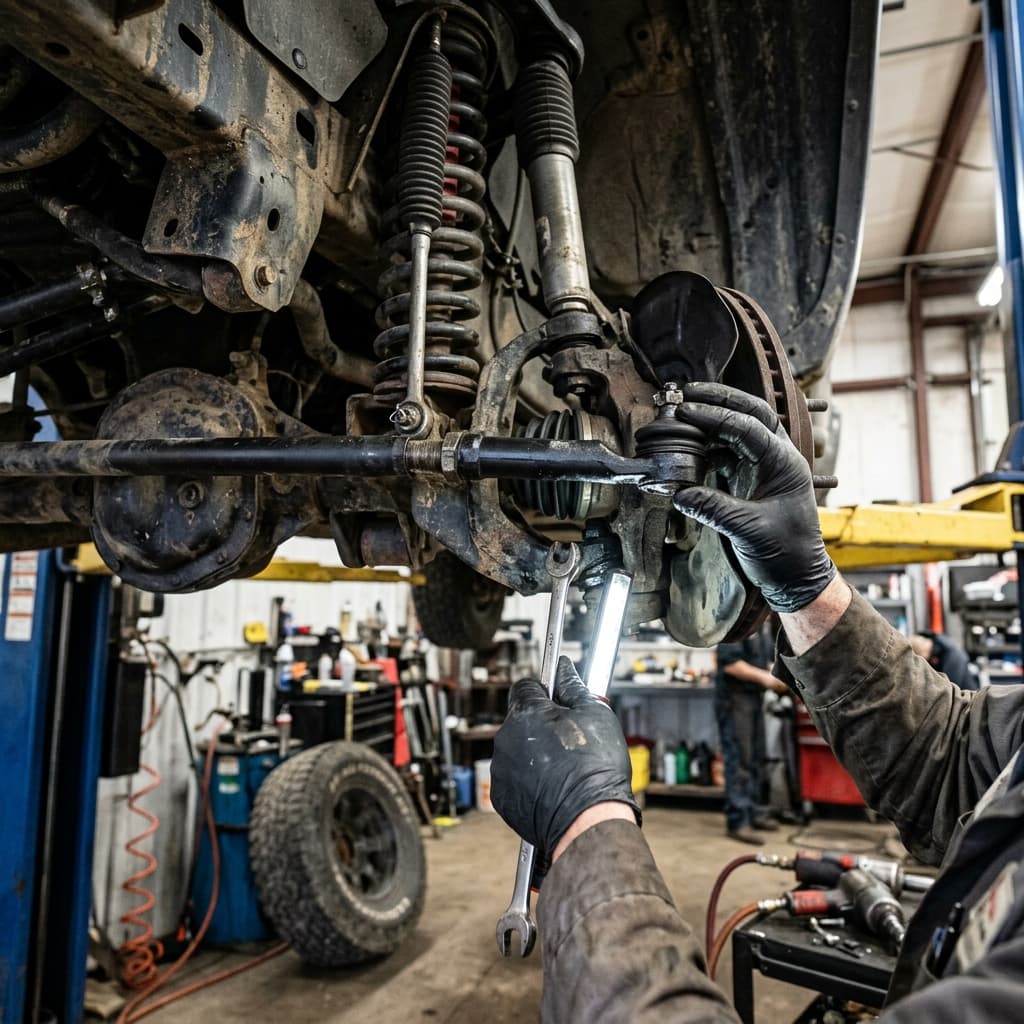
Your tie rods are small but critical. They're the mechanical link between your steering rack and your front wheels — and when one fails, you can lose the ability to steer the vehicle entirely. Knowing the warning signs gives you the chance to fix a bad tie rod before it becomes a roadside emergency.
What Do Tie Rods Do?
When you turn the steering wheel, the steering rack (or steering gear on older vehicles) moves laterally. Tie rods convert that lateral motion into rotational force at the steering knuckle, which pivots the wheel left or right. Every front wheel has its own tie rod assembly, so you have a left and right on each side.
The tie rod also plays a direct role in wheel alignment — specifically the toe angle, which controls whether your front tires point slightly inward (toe-in) or slightly outward (toe-out). This is why a worn tie rod causes both handling problems and tire wear simultaneously.
Inner vs. Outer Tie Rod Ends
Each tie rod assembly has two joints:
- Outer tie rod end — Located at the wheel hub end, visible behind the wheel. It's a ball-and-socket joint encased in a rubber boot filled with grease. Because it's exposed to road debris, water, and constant movement, it wears faster and fails more often. It's also easier to replace.
- Inner tie rod end — Located where the tie rod connects to the steering rack, deep in the engine bay. It's a threaded pivot joint and requires more labor to access. When an inner tie rod fails, the symptoms are often more severe because it's closer to the rack itself.
Between the inner and outer ends is an adjustable sleeve — the length of this sleeve is what your alignment technician adjusts to set your toe angle. This is why replacing a tie rod end always requires a realignment.
Symptoms of a Bad Tie Rod
1. Loose, Vague, or Wandering Steering
This is the most common and most dangerous symptom. If your steering feels "numb," requires constant micro-corrections to stay in your lane, or the wheel seems to float without responding crisply to your inputs, a worn tie rod end is a prime suspect. The worn ball joint allows the wheel to move slightly independent of your steering input — creating that unsettling, disconnected feel.
2. Clunking or Knocking Noise
As the ball-and-socket joint in the tie rod end wears, it develops play — a small amount of looseness in the joint. Every time that loose joint reaches the end of its travel (when you hit a bump, turn the wheel sharply, or transition from braking to acceleration), it clunks. The noise is often described as a metallic knock from the front corner of the vehicle.
3. Uneven or Rapid Tire Wear
Because tie rods control toe alignment, a worn tie rod causes the affected wheel to point at a slight angle instead of straight ahead. Driving with incorrect toe wears the inner or outer edge of the tire extremely fast — sometimes wearing a tire down to the cords in 5,000–10,000 miles instead of the normal 40,000–60,000. If you see feathering or sharp edge wear on your front tires, a tie rod inspection is warranted.
4. Vehicle Pulls to One Side
If one tie rod is significantly more worn than the other, the unequal play creates an asymmetric toe situation. The vehicle will drift or pull toward the side with more wear during normal straight-line driving. This can be confused with an alignment problem or brake issue, but tie rod play is often the root cause.
5. Vibration or Shimmy in the Steering Wheel
A severely worn outer tie rod end can cause the front wheel to oscillate or "flutter" at speed, transmitting a shimmy or vibration back through the steering column. This is different from the speed-specific vibration of wheel imbalance — tie rod shimmy tends to be more erratic and is accompanied by loose steering feel.
6. Visible Damage or Failed Boot
During routine inspection, a technician will look at the rubber boot covering the tie rod end ball joint. If the boot is cracked, torn, or missing, road water and grit have contaminated the grease inside — and the joint is actively wearing out even if symptoms haven't fully developed yet.
The Steering Play Test — Check It Yourself
You can do a basic check at home with the vehicle safely parked and the wheels on the ground:
- Grab the front tire at the 9 o'clock and 3 o'clock positions (sides of the tire).
- Push and pull firmly left and right.
- Feel and listen for any clunking, knocking, or visible movement in the tie rod end.
Then try the 12 o'clock and 6 o'clock positions (top and bottom) — that tests ball joints more than tie rods. Any distinct clunk or visible looseness warrants a shop inspection. Note: a small amount of play is normal in the steering wheel itself, but movement in the tie rod joint is not.
How Technicians Diagnose Tie Rod Wear
Professional diagnosis involves lifting the vehicle on a hoist so the suspension hangs freely (unloading it). With the wheel hanging:
- The technician grabs the tire at 9 and 3 and shakes it, watching the tie rod end for play.
- An assistant holds the steering wheel steady while the tech checks whether the wheel moves when the tire is wiggled.
- A pry bar is sometimes used to apply controlled force to the tie rod end while watching for joint movement.
Inner tie rod play is checked by feeling for movement in the steering rack boot while the tie rod is loaded. Some shops use an alignment machine to measure toe change under load as a further diagnostic.
Tie Rod Replacement Cost
Costs vary by vehicle, but here are typical ranges for the Atlanta metro and North Texas markets:
- Outer tie rod end: $80–$200 (parts + labor, one side). Outer ends are straightforward to access and replace.
- Inner tie rod end: $150–$350 (parts + labor, one side). Inner ends require more disassembly and time.
- Both sides (if symmetric wear): Many shops recommend replacing both sides simultaneously if one is worn, since they've lived the same life.
- Wheel alignment (always required after): $75–$125 for a standard front two-wheel alignment. Never skip this — replacing a tie rod end changes the toe angle, and driving without realignment will wear out your new tires rapidly.
Total cost for a single outer tie rod with alignment: typically $155–$325. Inner tie rod with alignment: $225–$475.
How Long Can You Drive with a Bad Tie Rod?
This depends entirely on severity — but the honest answer is: not long, and not at all if it's severe. A mildly worn tie rod end (minor play, beginning symptoms) should be addressed within a week or two. A severely worn or failing tie rod end is a genuine safety emergency. A tie rod that separates completely causes instant, total loss of steering control — the wheel collapses inward and the vehicle cannot be steered at all.
If symptoms are present and worsening — especially if the clunking is loud, the steering is significantly loose, or you feel a shimmy at speed — do not delay. Have the vehicle towed or driven directly to a shop.
Tie Rods and Wheel Alignment — The Direct Connection
Your alignment tech sets your toe angle by threading the outer tie rod end in or out of the adjustable sleeve — which is why an alignment is a mandatory step after any tie rod replacement. But it also works in reverse: a worn tie rod with play cannot hold a precise toe setting, so your alignment will drift even if it was perfect last month.
If you've had your alignment adjusted repeatedly and it never seems to hold, or your tires keep wearing unevenly despite "good" alignment readings, worn tie rod ends are a likely culprit.
FAQ: Bad Tie Rods
What does a bad tie rod feel like?
The most common feeling is loose, vague, or wandering steering — the car requires constant small corrections to stay straight. You may also feel clunking over bumps and, in severe cases, a shimmy or vibration through the steering wheel.
Can I drive with a bad tie rod?
Only with mild wear and only in the short term. A severely worn or failing tie rod is a safety emergency — if it separates, you lose steering completely. Get it inspected immediately if symptoms are worsening.
How much does tie rod replacement cost?
Outer tie rod: $80–$200 per side. Inner tie rod: $150–$350 per side. Add $75–$125 for the required wheel alignment. Total for a typical outer tie rod repair: $155–$325.
Do I need an alignment after replacing a tie rod?
Yes, always. The tie rod end adjusts the toe angle, and any change to it — including removal and reinstallation of the same part — disrupts the alignment setting. Skipping the alignment will cause rapid, uneven tire wear.
Don't Compromise on Steering Safety
At Chloe's Auto Repair & Tire, we inspect tie rod ends during every multi-point inspection and oil change. If we find play, we'll show you exactly what we found and give you an honest estimate before we touch anything. A complete vehicle inspection is the best way to catch tie rod wear before it becomes a safety issue. Tie rod replacement is part of our comprehensive steering and suspension repair service — with five locations across metro Atlanta, Roswell, and Spring, TX, you're never far from a shop that will give it to you straight.