
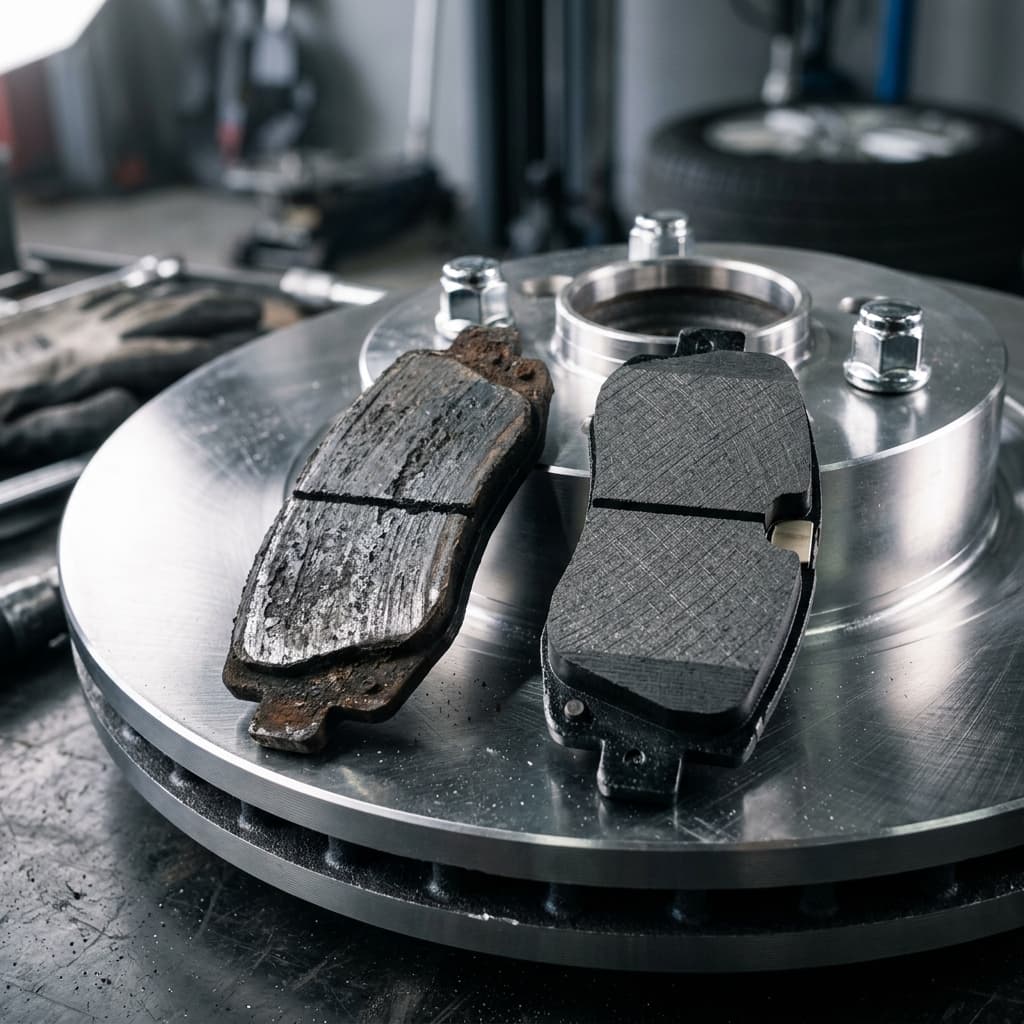
Brake pads typically last 25,000 to 70,000 miles — but that's a wide range for a reason. A set of organic pads on a compact car driven mostly on the highway can last 60,000+ miles. The same vehicle driven by an aggressive city commuter can chew through pads in under 20,000. The number your mechanic quotes means nothing without knowing *how* you drive, *what* you drive, and *what type of pad* is on the vehicle. Here's the real breakdown.
What Determines Brake Pad Lifespan
Five factors drive how fast your brake pads wear down. Understanding them helps you predict service intervals — and tells you whether a short lifespan is normal for your situation or a sign of a problem.
1. Driving Style (The #1 Factor)
Nothing wears brake pads faster than how often and how hard you use them. A driver who brakes early and coasts to stops puts far less heat and mechanical stress on pads than someone who rides the brakes or waits until the last moment to stop. City driving — stop signs every block, traffic lights, aggressive acceleration followed by hard stops — can cut pad life in half compared to highway miles where you might go 10 minutes without touching the brake pedal. This is the single biggest variable in pad lifespan, and it's entirely within your control.
2. Vehicle Weight
Physics doesn't negotiate. A heavier vehicle carries more kinetic energy at any given speed, and the brakes have to convert all of that energy into heat to slow the vehicle down. A 6,000-pound truck or full-size SUV will wear brake pads significantly faster than a 3,000-pound compact sedan, even with identical driving habits. That's why trucks and large SUVs often need brake service a third sooner than smaller vehicles.
3. Pad Material
Not all brake pads are built the same. The friction compound determines both how long the pad lasts and how it performs under different conditions:
| Pad Type | Typical Lifespan | Notes |
|---|---|---|
| Organic (NAO) | 25,000–40,000 mi | Soft, quiet, gentle on rotors — wears fastest |
| Semi-Metallic | 30,000–60,000 mi | Best all-around performance and longevity |
| Ceramic | 40,000–70,000 mi | Longest lasting, low dust, quieter — premium cost |
4. Rotor Condition
Warped, grooved, or heavily scored rotors accelerate pad wear significantly. When a rotor surface isn't smooth and flat, the pad only makes contact with the high spots — concentrating wear rather than spreading it across the full surface area. A rotor that's below minimum thickness spec also runs hotter, which degrades the pad compound faster. If you're replacing pads unusually quickly, always have the rotors measured. Installing new pads on a damaged rotor is money wasted.
5. Terrain
Hilly or mountainous areas demand more braking than flat terrain — it's unavoidable. If you live in areas with significant elevation change, expect to see pads wear on the shorter end of their rated range. Even regular highway driving with long, shallow downhill grades adds up. Flat terrain, by contrast, is genuinely easier on brakes.
How Long Do Brake Pads Last By Vehicle Type
| Vehicle Type | Typical Pad Lifespan | Why |
|---|---|---|
| Compact Car | 40,000–70,000 mi | Low curb weight, less kinetic energy to stop |
| Mid-Size Sedan | 35,000–60,000 mi | Moderate weight, depends heavily on driving style |
| SUV / Crossover | 30,000–50,000 mi | Heavier, higher center of gravity, more brake demand |
| Truck / Full-Size Van | 25,000–45,000 mi | High curb weight, often loaded or towing |
How Long Do Brake Pads Last By Driving Style
| Driving Style | Typical Pad Lifespan | Notes |
|---|---|---|
| Mostly Highway | 50,000–70,000 mi | Minimal brake use, pads wear slowly |
| Mixed City/Highway | 35,000–55,000 mi | Average commuter — the standard baseline |
| City / Stop-and-Go | 20,000–40,000 mi | Constant low-speed braking wears pads fast |
| Aggressive / Performance | 15,000–30,000 mi | Hard, late braking generates extreme heat |
How to Check How Much Life Your Pads Have Left
Look Through the Wheel Spokes
On most vehicles you can get a visual on the brake pad without removing the wheel. Look through the spokes of your wheel at the brake caliper. You should be able to see the outer pad pressed against the rotor. A healthy pad will show at least ¼ inch (about 6mm) of friction material. If it looks thin — paper-thin or barely visible — it's time to have them measured.
The Penny Test Doesn't Work Here
The penny test is for tires. With brake pads, there's no equivalent coin trick that tells you anything useful. Pad thickness varies by vehicle design, caliper size, and original pad thickness. What looks thin on one vehicle may be perfectly normal on another. Stick to measurement in millimeters — or have a shop do it.
Professional Measurement in Millimeters
This is how it should actually be done. A technician removes the wheel and measures the remaining friction material:
- New pad: 10–12 mm of friction material
- Replace soon: 4–5 mm (plan for service within the next oil change)
- Replace now: 3 mm (safety threshold)
- Urgent — do not delay: 2 mm or less (metal-to-metal contact imminent)
At Chloe's Auto Repair & Tire, we measure pad thickness at every service visit and show you the actual numbers — not just "you need brakes."
The Wear Indicator Squeal
Modern brake pads have a small metal tab — the wear indicator — built into the pad. When the friction material wears down to the minimum safe thickness, this tab contacts the rotor and produces a high-pitched squealing sound when you're driving (not braking). This squeal is intentional. It's the pad telling you it's time. Don't ignore it — that sound means you have maybe a few thousand miles before the backing plate starts grinding against the rotor.
Front vs. Rear Brake Pads: Why They Wear Differently
Your front brake pads will almost always wear faster than the rears — often 40% to 60% faster. The reason is simple physics: when you brake, vehicle weight transfers forward, pushing the front tires harder into the pavement and requiring the front brakes to do more work. On most passenger vehicles, the front brakes handle roughly 70% of total braking force. The rear brakes handle the remaining 30%.
This means it's completely normal to replace front pads twice before touching the rears. Some vehicles with rear-biased brake bias (certain sports cars and rear-heavy vehicles) flip this, but for the average sedan, SUV, or truck — front pads first, every time.
Rear disc brakes on vehicles with an integrated parking brake mechanism ("caliper parking brake") are also prone to premature wear if the parking brake mechanism seizes. If your rear pads are wearing faster than the fronts, have the rear calipers inspected for seizing.
Pad Material Comparison: Ceramic vs. Semi-Metallic vs. Organic
Organic pads (also called NAO — Non-Asbestos Organic) are made from materials like rubber, glass, and resin. They're soft, quiet, and gentle on rotors, which is why they're common on economy vehicles. The trade-off: they wear faster, generate more brake dust, and fade more quickly under repeated hard stops. Lifespan: 25,000–40,000 miles.
Semi-metallic pads contain 30–65% metal particles (steel wool, copper, iron) embedded in a binding resin. This makes them significantly harder and more durable than organic pads, with better heat dissipation and performance under load. They're slightly noisier and harder on rotors, but for most real-world driving — including towing, heavy vehicles, and varied terrain — they're the best balance of cost and performance. Lifespan: 30,000–60,000 miles.
Ceramic pads are made from ceramic fibers and bonding agents. They last longest, produce the least brake dust, run quieter, and perform consistently across a wide temperature range. They're also the most expensive option and don't handle extreme track-day heat as well as performance semi-metallic pads. For everyday street driving, ceramic is the premium choice. Lifespan: 40,000–70,000 miles.
Bottom line: if you're replacing pads and wondering whether to upgrade, ceramic or semi-metallic will outlast organic pads and cost you less per mile over time.
Signs Your Pads Are Getting Close
Don't wait for metal-on-metal grinding to act. These are the warning signs that brake service is approaching or overdue:
Squealing when driving (not braking): This is the wear indicator. Your pads are near the minimum. Schedule service this week.
Squealing or grinding when braking: If the squeal happens *while* braking, the pads may be dusty or glazed — or already worn. Grinding means metal on metal. Stop driving and get it inspected immediately.
Brake pedal vibration: Pulsation through the pedal usually means warped or unevenly worn rotors. Often happens alongside worn pads since degraded pads cause rotor damage.
Car pulling to one side under braking: One caliper is applying more force than the other. Could be a seized caliper, uneven pad wear, or a stuck slide pin. Needs immediate diagnosis.
Longer stopping distances: If your car takes noticeably more distance to stop than it used to — especially in emergency situations — the pads are either worn or the braking system has a problem. This is a safety issue, full stop.
Brake dust is suddenly less visible on your wheels: Counterintuitive, but true. Worn pads produce less brake dust because there's less friction material being shed. If you suddenly notice cleaner wheels without changing anything, it can indicate the pad material is nearly gone.
What Happens If You Don't Replace Pads In Time
Here's the cost escalation that happens when pad replacement gets ignored:
| Stage | What's Happening | Typical Repair Cost |
|---|---|---|
| Wear indicator squealing | Pads at minimum — still safe to drive short-term | Pads only: $150–$300/axle |
| Pads worn past 2mm | Safety margin gone — metal contact imminent | Pads + likely rotor resurface |
| Metal-to-metal contact | Backing plate grinding rotor — rotor damaged | Pads + new rotors: $300–$600/axle |
| Rotor deeply scored | Rotor beyond resurfacing — needs replacement | $400–$700+/axle |
| Caliper damage | Extreme heat damages caliper seals/pistons | Add $200–$400/caliper |
| Brake failure | System compromise — accident risk | No dollar amount covers this |
A set of brake pads replaced on time costs $150–$300 per axle at most shops. Wait until the rotor is destroyed and you're looking at $400–$700+ for the same axle. The math strongly favors staying ahead of it.
If you're hearing any brake noise, seeing warning lights, or just haven't had your brakes checked recently, our brake repair service includes a full brake inspection with measurements at no charge during any service visit.
Frequently Asked Questions
How often should brake pads be replaced?
There's no universal mileage interval because driving style and vehicle weight vary so much. As a baseline, plan on checking pad thickness every 12,000–15,000 miles or at every other oil change. Replace when pads measure 3mm or less — or immediately if you hear grinding. Most drivers end up replacing pads every 2–4 years depending on how they drive.
Do all 4 brake pads wear at the same rate?
No. Front pads wear significantly faster than rear pads on most vehicles — often 40–60% faster — because the front brakes handle roughly 70% of braking force. It's normal to replace front pads twice for every one rear pad replacement. Additionally, left and right pads on the same axle should wear evenly. If one side is wearing faster than the other, a seized caliper or stuck slide pin is usually the cause.
How do I know if my brake pads are worn?
The most reliable methods: (1) Have a shop measure them in millimeters at each oil change — this is the only truly accurate method. (2) Listen for the wear indicator squeal while driving with the windows down and radio off. (3) Look through the wheel spokes — if the pad material looks paper-thin against the rotor, it's time. (4) Note any change in stopping distance, pedal feel, or brake noise. Any of these signs warrant an inspection.