
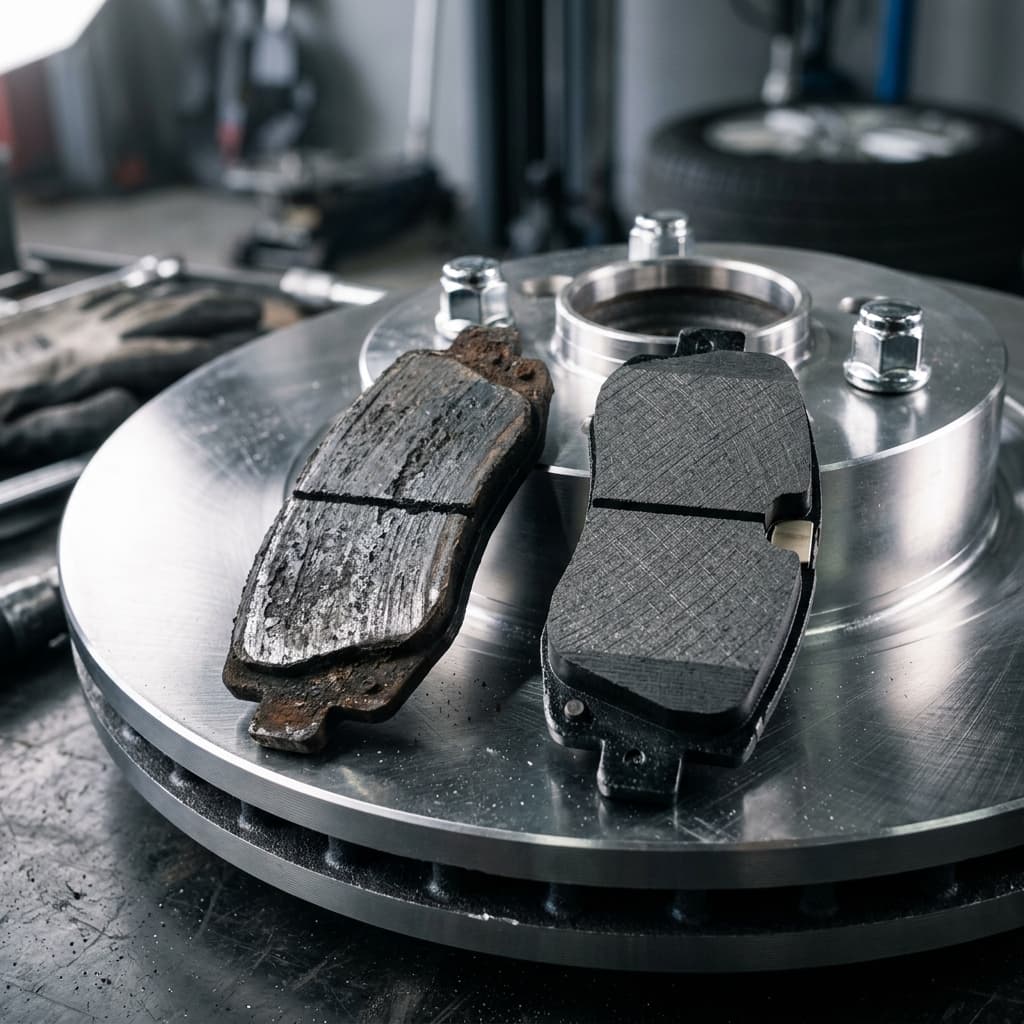
A grinding noise when braking is metal-on-metal contact — and it means your brake system needs attention now. Unlike the high-pitched squeal you get from brake wear indicators (which are designed to warn you weeks before a problem), grinding is a sign that protection has already been lost. The sound can range from a low, rhythmic scraping to a harsh metallic groan that you feel through the brake pedal. Either way, don't ignore it.
Squealing brakes get your attention. Grinding brakes should make you pull over and call a shop. Here's the full breakdown of what's causing it, how dangerous it is, and what it'll cost to fix.
The 4 Main Causes of Brake Grinding
1. Worn Brake Pads — Completely Through the Friction Material
This is the most common cause by far. Brake pads are designed with a steel wear indicator — a small tab that contacts the rotor and produces a squeal when pads wear down to about 2–3mm of friction material remaining. That squeal is your warning. If you drove through the squeal phase without getting service, the pad's friction material is now gone, and the steel backing plate is contacting the rotor directly. That's the grinding you're hearing.
At this stage, the rotor is being scored and machined by the steel plate every time you brake. What started as a pad replacement job has now likely become a pads-plus-rotors job. Leave it longer and the caliper bracket starts getting damaged too. The longer you wait, the more metal gets destroyed and the higher the repair bill climbs.
2. Rock or Debris Caught Between Pad and Rotor
Small rocks, gravel, or road debris can get lodged in the tight gap between the brake pad and the rotor face. When this happens, the debris acts like a grinding wheel — scoring the rotor surface with every wheel rotation. The grinding tends to be constant (not just during braking) and often disappears on its own as the debris works itself out or gets pulverized.
If the grinding stops after a few miles, this is the likely culprit. If it persists, something else is going on. Either way, have the rotors inspected — scoring from debris can be deep enough to require resurfacing or replacement.
3. Rusty Rotors — Morning Surface Rust vs. Chronic Corrosion
There's a crucial difference between normal overnight rust and the kind of rust that causes real problems. Steel rotors oxidize quickly when exposed to moisture — a single night with dew or rain is enough to put a thin layer of rust across the rotor face. This surface rust causes a brief grinding or scraping sensation on the first few stops of the morning, then polishes off completely as the pads wipe the rotor surface clean. This is completely normal and not a cause for concern.
Chronic corrosion is different. If your vehicle has been sitting for weeks or months, or if the rotors are old and the edges have built up deep rust ridges (called rust lip), the grinding can persist even after multiple stops. These rust ridges can prevent the brake pad from making full, even contact with the rotor and can even catch and tear pad material. If the grinding doesn't clear up after 5–6 normal stops, the rust is more than surface-deep and needs professional evaluation.
4. Seized Brake Caliper Dragging on the Rotor
A brake caliper applies clamping force by pushing the pads against the rotor when you press the brake pedal. The caliper's pistons are supposed to retract when you release the pedal, letting the rotor spin freely. When caliper pistons or slides seize up from corrosion or damage, the pad stays pressed against the rotor even when you're not braking.
A seized caliper produces grinding that happens during normal driving — not just when braking — and the affected wheel will often run noticeably hotter than the others. You might also notice the car pulling to one side, or one wheel dragging noticeably. Left unaddressed, a seized caliper will destroy a rotor in a matter of days and can create enough heat to damage the wheel bearing.
How Urgent Is Grinding?
Not all brake grinding is equally urgent. Here's a practical guide:
| Cause | Urgency | Drive or Tow? |
|---|---|---|
| Worn pads through to metal backing | High | Drive carefully to shop today — avoid highways |
| Rock/debris caught in brake | Low–Medium | Drive normally; monitor for a few miles |
| Morning surface rust (clears after 3–4 stops) | None | Normal — no action needed |
| Rust lip on old rotors (persistent grinding) | Medium | Schedule service within a week |
| Seized caliper dragging | High | Drive to shop; tow if wheel is extremely hot or pulling badly |
What Happens If You Keep Driving on Grinding Brakes
Every mile you drive with metal-on-metal braking causes progressive damage — and the cost escalates fast:
| Stage of Neglect | What Gets Damaged | Estimated Repair Cost |
|---|---|---|
| Pads worn to metal — caught early | Pads only (rotors possibly salvageable) | $150–$300/axle |
| A few hundred miles on metal backing | Pads + scored rotors | $300–$600/axle |
| Extended driving on bare metal | Pads + rotors + caliper bracket damage | $500–$1,000/axle |
| Severe neglect / seized caliper heat damage | Pads + rotors + caliper + wheel bearing | $800–$1,500+/axle |
The friction material on a brake pad exists specifically to protect the rotor and caliper from metal contact. Once that material is gone, you're destroying expensive components every mile you drive. A $150 pad replacement becomes a $600 job in a week of normal commuting.
There's also a safety dimension that isn't about money: heavily scored rotors have dramatically reduced stopping power, and a seized caliper can cause sudden, unpredictable brake pull that puts the vehicle into oncoming traffic. At some point this stops being a maintenance issue and becomes a safety emergency.
Grinding After Sitting / First Morning Stop
This is one of the most common reasons people call about grinding brakes — and about half the time, it turns out to be nothing. Here's how to tell the difference:
Normal morning rust behavior: You back out of the driveway, apply the brakes, and hear a brief scrape or groan. By the end of the street, it's gone. This is iron oxide (rust) on the rotor face being wiped clean by the pads. It's more noticeable after rain, overnight dew, or humid nights. Steel rotors are not stainless — they rust. This is expected.
Grinding that warrants attention: The grinding doesn't go away after 5–6 normal braking applications. It's still present after you've driven a mile or two. It's accompanied by a metallic smell. You feel a vibration or pulsation through the brake pedal along with the sound. The steering wheel pulls when you brake. Any of these alongside the grinding means something more than surface rust is going on.
If your vehicle has been sitting for more than two or three weeks — especially outdoors in humid or rainy conditions — the rust can be thick enough to require several miles of driving before it clears. That's still normal, but worth monitoring. If it takes more than 10–15 minutes of driving and multiple brake applications to clear, have the brakes inspected.
Typical Repair Costs for Brake Grinding
Costs vary by vehicle (European cars and trucks tend toward the high end), location, and how much damage has been done. These ranges reflect typical prices at an independent shop in the Atlanta metro area:
Brake pads only (both wheels, one axle): $150–$300
This is the best-case scenario — caught before the rotors are damaged. Includes new pads, lubrication of caliper slides, and inspection. Labor is about 30–45 minutes per axle.
Brake pads + rotors (one axle): $300–$600
The most common grinding repair. Rotors are typically replaced rather than resurfaced when they've been scored by metal contact, because the damage is uneven and removing enough material to clean it up often brings the rotor below minimum thickness spec (usually around 0.030" above the discard spec). New rotors spin true and give you a fresh braking surface.
Brake pads + rotors + caliper (one axle): $450–$900
Required when a caliper has seized or when the caliper bracket is damaged from prolonged metal-on-metal contact. A rebuilt or remanufactured caliper is installed. At Chloe's, every brake repair service includes a full caliper slide and hardware inspection — catching a sticking caliper early keeps this repair off the bill.
If both axles are affected (front and rear both grinding), double these figures. Most vehicles do about 70% of their braking at the front axle, so front pads wear faster — rear brakes lasting noticeably longer is normal.
How to Know If You Need to Pull Over Now
Most brake grinding situations allow you to drive carefully to a shop rather than calling a tow truck — but these signs mean you should stop immediately:
- The brake pedal is going toward the floor before the car stops — you've lost significant braking power
- The car pulls hard to one side when you apply the brakes — a seized caliper is generating unbalanced braking force
- You smell burning from a wheel — a dragging caliper is generating dangerous levels of heat that can cause brake fluid to boil or a tire fire
- The wheel is too hot to approach after a normal stop — that level of heat indicates a fully seized caliper destroying the rotor and potentially damaging the wheel bearing
- You hear a loud clunk or bang along with the grinding — brake hardware may have broken loose
If any of these are present, don't drive the vehicle. Call for a tow. A seized caliper generating that much heat can fail catastrophically, and driving with significantly reduced braking power on Atlanta highways is not a risk worth taking.
For anything less severe — a grinding that's new, consistent, and unaccompanied by pedal feel changes or pulling — drive carefully to a shop without making any sudden stops. Keep your following distance generous and avoid highway speeds.
Frequently Asked Questions
Is it safe to drive with grinding brakes?
Not for long. Metal-on-metal braking reduces your stopping power and destroys expensive components with every mile. If the grinding just started and your pedal feels normal, you can generally drive carefully to a shop — same day, not next week. If you have any pedal softness, pulling, or heat coming from a wheel, stop driving and get a tow. There is no version of "I'll drive on it a little longer" that ends with a lower repair bill.
Can I just replace pads and not rotors if they're grinding?
Only if the rotors measure above minimum thickness and the grinding was caused by debris or very early metal contact. A technician will measure rotor thickness with a micrometer — typically needing at least 0.030" above the manufacturer's discard spec to resurface safely, and more to justify the labor cost of machining. Rotors scored by a steel backing plate almost always need replacement. Putting new pads on a damaged rotor results in uneven pad bedding, brake pulsation, and premature pad wear — it's a false economy.
How long can I drive on grinding brakes?
This is the wrong question — the right question is how much do you want the repair to cost. A fresh metal-on-metal grind that started today: maybe a day or two of conservative local driving before rotor damage becomes severe. A grind you've been hearing for a week: the rotors are almost certainly already scored, the caliper may be getting damaged, and the repair is already more expensive than if you'd come in when you first heard it. The answer is: as few miles as possible, driven as gently as possible.
What does brake grinding sound like vs squealing?
Squealing is high-pitched — almost a shriek — and typically consistent during braking. It's designed to be annoying precisely so you'll notice it. Squealing is the wear indicator tab dragging on the rotor. It means you have 2–4 weeks before you're in the grinding phase. Grinding is lower in pitch, more metallic and gravelly, and often pulsates in rhythm with wheel rotation. You can sometimes feel it through the brake pedal or steering wheel. Some pads also squeal from cold temperatures or dust buildup — that kind of squeal goes away after a few minutes of driving and is nothing to worry about. Grinding never goes away on its own (except the brief morning rust case). If you're unsure which you're hearing, get it looked at — a brake inspection takes about 15 minutes.