
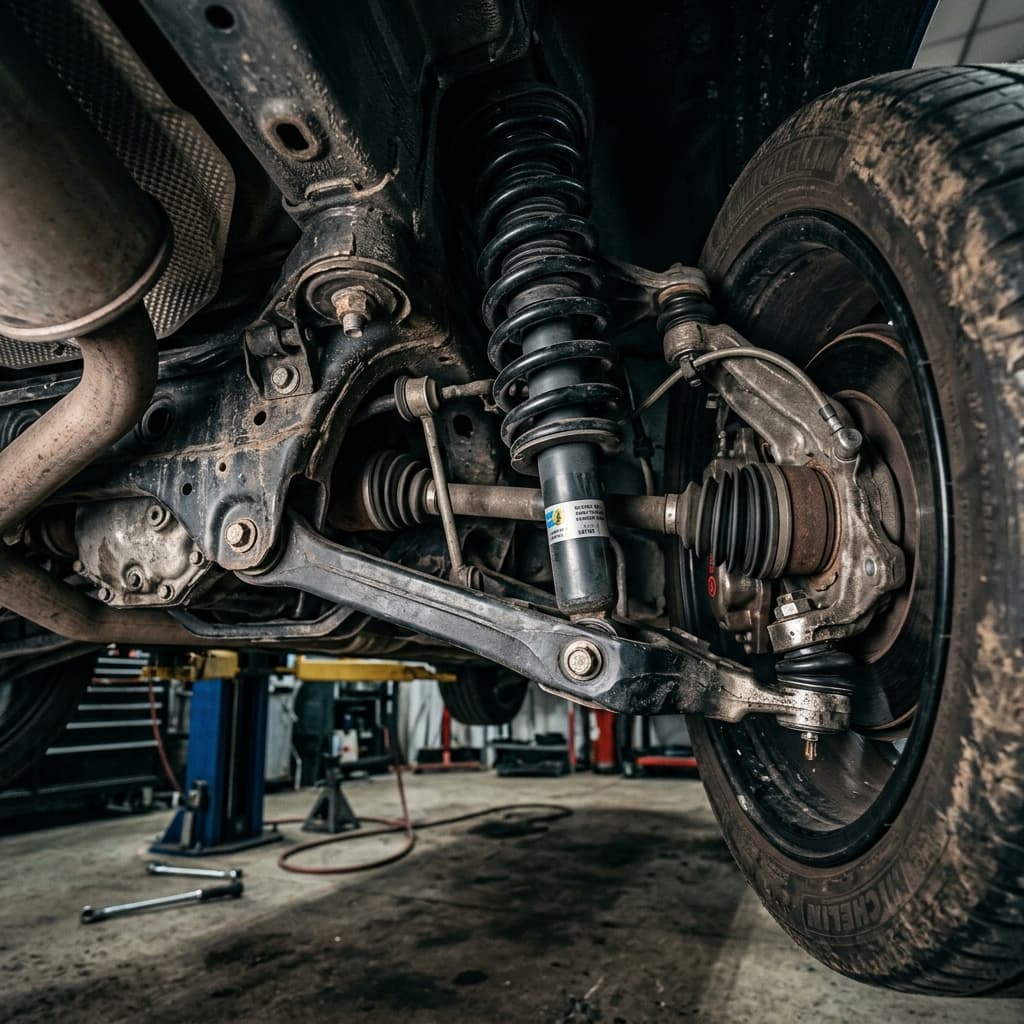
A car that shakes or vibrates is telling you something — but what it's telling you depends entirely on when the shaking happens and where you feel it. Shaking only at 65 mph? Different problem than shaking at idle. Shaking through the steering wheel only? Different than through the whole car. Shaking when braking? That's its own category entirely.
This is one of the most commonly misdiagnosed complaints in auto repair because there are a dozen causes and the symptom alone doesn't identify which one. But the pattern does.
Shaking That Starts at Highway Speed (60–75 mph)
This is the most common shaking complaint and the cause is almost always one of two things:
Out-of-balance wheels. The most frequent culprit. Every wheel and tire assembly needs to be perfectly balanced — weight distributed evenly around the rotation axis. When a wheel is out of balance (from a lost wheel weight, a patch of uneven tread wear, or normal wear on the wheel weight itself), it wobbles at high speed. The vibration is typically felt through the steering wheel or floor between 60–75 mph and may smooth out above 80 mph. Fix: wheel balancing, $15–$25 per wheel. Often the cheapest repair on this list.
Bent wheel or tire with flat spot or bubble. A pothole or curb strike can slightly bend a wheel or damage the tire structure. A damaged tire can have a flat spot (from hard braking or sitting), a belt separation, or a bubble — any of these causes rhythmic vibration at speed. Inspect tires visually and with the car on a lift for runout. A damaged wheel or tire needs replacement, not balancing.
Worn or failing CV axle. A worn CV joint can cause vibration at highway speeds that changes character on turns. If the shaking gets worse when turning slightly in one direction at speed, a CV joint is likely. Cost: $250–$550 per axle.
Shaking at Low Speed or in a Narrow Speed Range
Tire runout. Not the same as balance. Runout means the tire or wheel isn't perfectly round — it has a high spot that contacts the road once per revolution. This produces a thumping or rhythmic vibration in a specific speed range (often 25–45 mph) that goes away above or below that range. Diagnosis requires measuring runout on a machine. Sometimes corrected by remounting the tire; sometimes a replacement tire or wheel is needed.
Brake rotor warping (shaking when braking). If the shaking only happens when applying the brakes — especially from highway speed — the rotors are almost certainly warped or have developed thickness variation. The pads grab the high spot on every revolution, causing a pulsing through the brake pedal and steering wheel. Fix: rotor resurfacing (if thickness allows) or replacement. $200–$450 per axle depending on rotors needed.
Tire feathering from alignment issue. Tires with a feathered wear pattern (smooth one direction, sharp the other) cause a rhythmic vibration at lower speeds that disappears at highway speed. The root cause is a toe alignment problem. Fix: alignment ($100–$175) plus new tires if wear is severe.
Shaking at Idle or When Stopped
Engine misfire. A misfiring cylinder causes the engine to run unevenly, and that vibration transmits through the drivetrain and body. Rough idle shaking that's worse when in drive at a stoplight is characteristic of a misfire. The RPMs may hunt or fluctuate. Check engine light is usually on. See our post on engine misfire symptoms for the full diagnosis.
Worn or collapsed engine/transmission mounts. Motor mounts isolate the engine's natural vibration from the chassis. When they wear out or collapse, engine vibration transmits directly to the body — most noticeable at idle and during acceleration. Shaking that's especially bad when you first put the car in gear or during hard acceleration points to a mount. Cost: $200–$450 per mount.
Dirty or failing throttle body/IAC. A dirty throttle body or idle air control valve causes uneven air delivery at idle, producing a surging or shaking idle. Often accompanied by rough idle codes. Cleaning: $75–$150. Replacement: $150–$350.
Shaking That Pulls to One Side
Alignment problem. If the car shakes and drifts to one side, the suspension geometry is off. Often caused by a pothole impact or a worn suspension component (control arm bushing, ball joint) that's changed the alignment. Fix: alignment after any necessary component replacement.
Uneven brake application. A seized brake caliper on one side creates drag and pulls the car that direction, with accompanying heat and vibration. You'll often smell the brake as well. A caliper stuck applying also causes the car to pull under braking.
Shaking Through the Steering Wheel Specifically
Worn tie rod ends or ball joints. Loose steering or suspension components create play that translates to steering wheel shaking, especially over bumps or during slight direction changes. A steering and suspension inspection with the car on a lift — where a technician can check for play by hand — will identify this.
Power steering issue. A failing power steering pump or air in the hydraulic lines can cause steering wheel shudder and vibration, typically most noticeable at low speeds or during parking maneuvers.
Shaking Repair Costs at a Glance
| Cause | Typical Repair Cost |
|---|---|
| Wheel balancing (all 4) | $60–$100 |
| Tire replacement (each) | $100–$250+ |
| Wheel replacement | $150–$400 |
| Brake rotor resurfacing | $80–$150/axle |
| Brake rotor replacement | $200–$450/axle |
| CV axle replacement | $250–$550 |
| Motor mount replacement | $200–$450 per mount |
| Tie rod end replacement | $150–$350 |
| Ball joint replacement | $200–$400 per joint |
| Wheel alignment | $100–$175 |
Frequently Asked Questions
Is it safe to drive a shaking car?
Depends on the cause. Wheel balance or a minor tire issue — generally drivable short-term. Brake pulsing — drivable but get it checked soon, as warped rotors reduce braking effectiveness. Engine misfire — drivable with a steady CEL, not with a flashing CEL. A shaking car that pulls to one side or shakes during braking should be diagnosed before highway driving.
Why does my car only shake at 65–70 mph and not above or below?
This is the signature pattern of an out-of-balance wheel. Every wheel has a natural resonant frequency — the speed at which an imbalance causes maximum vibration. Above that speed, the tire contacts the road differently and the vibration often diminishes. Wheel balancing ($60–$100 for all four) almost always fixes this.
My car shakes when braking from highway speed. Do I need new brakes?
You need new rotors, at minimum. The shaking under braking from highway speed is brake rotor warping or thickness variation — the pad grabs a high spot once per revolution. Rotors can sometimes be resurfaced on a lathe if they're thick enough; most shops recommend replacement for consistent results. Pads may or may not be needed depending on their condition.