
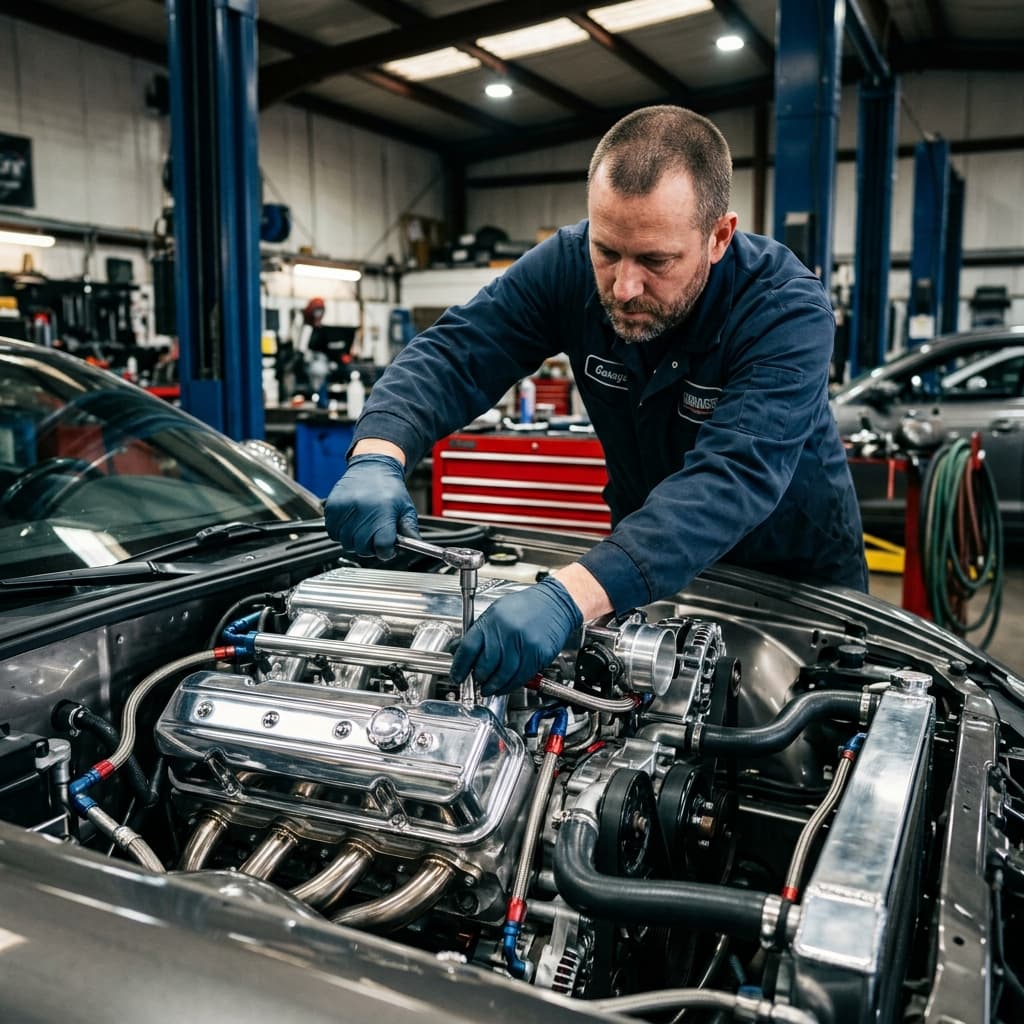
A misfire is exactly what the name says: a cylinder's combustion event either didn't fire at all, or fired so weakly it didn't produce meaningful power. Instead of a controlled explosion pushing the piston down, you get a partial burn or nothing — and the engine lurches, stumbles, or shakes to compensate with the cylinders that are still working.
That rough running is uncomfortable. The bigger problem is what happens in the exhaust: unburned fuel exits the cylinder and enters the catalytic converter. At operating temperature, the converter tries to finish burning that fuel — but it generates extreme heat doing so. A sustained misfire can melt the catalyst substrate inside the converter within minutes. Replacement cost: $800–$2,500. Which is why a flashing check engine light — always a misfire code — means stop driving, not drive carefully.
What Engine Misfire Feels Like
The symptoms depend on severity and how many cylinders are affected, but the pattern is consistent:
Rough or shaking idle. The most noticeable symptom at a stoplight. With one cylinder not contributing, the engine runs unevenly. The vibration transmits through the seat, steering wheel, and floor. A 4-cylinder engine misfiring on one cylinder is running at 75% power — the imbalance is pronounced. A V8 with one misfire is less dramatic but still detectable.
Stumbling or hesitation during acceleration. Stepping on the gas exposes the power deficit. The car hesitates, surges unevenly, or feels like it's pulling against resistance.
Loss of power. Especially noticeable on hills, merging, or passing. The engine simply can't produce its rated output with a cylinder not contributing.
Poor fuel economy. The ECU compensates for misfires by enriching the fuel mixture. More fuel in, same or less power out — fuel economy drops noticeably.
Raw fuel smell from the exhaust. Unburned fuel exiting through the exhaust smells like gasoline, not combustion byproducts.
Flashing check engine light. This specifically indicates an active, ongoing misfire severe enough to damage the catalytic converter. Not the same as a steady light. Pull over safely when you can.
Steady check engine light with rough running. A stored misfire code. Less urgent than flashing, but get it diagnosed this week.
The 8 Most Common Causes of Engine Misfire
1. Worn or fouled spark plugs. The most common cause by a wide margin. Spark plugs erode at the electrode over time — the gap widens, voltage requirements increase, and eventually the spark is too weak to reliably ignite the air-fuel mixture. Carbon fouling (from oil burning or rich running) can short the spark entirely. Most manufacturers recommend replacement every 30,000–60,000 miles for copper plugs, 60,000–100,000 for iridium or platinum. Many misfires disappear with a fresh set of plugs.
2. Failed ignition coil. Modern engines use coil-on-plug (COP) ignition — one coil per cylinder, sitting directly on top of the plug. When a coil fails, that cylinder loses spark entirely. The misfire code (P0301–P0308) will point to the specific cylinder, and a swap test — moving the suspect coil to a different cylinder and seeing if the misfire follows — confirms it quickly.
3. Clogged or leaking fuel injector. Injectors that are partially clogged can't deliver the correct spray pattern, causing a lean misfire. Injectors that leak deliver too much fuel, causing a rich misfire. Injector issues often produce misfires that change character with engine temperature — lean misfires are typically worse cold, rich misfires worse hot.
4. Vacuum leak. Any air that enters the intake manifold without being measured by the mass airflow sensor leans out the fuel mixture. A small vacuum leak causes a lean misfire that's most noticeable at idle (when the engine is most sensitive to unmetered air) and typically improves at higher RPM. Common leak points: intake manifold gaskets, throttle body gaskets, PCV hoses, and brake booster lines.
5. Low fuel pressure. If the fuel pump or pressure regulator isn't delivering adequate pressure, the entire engine runs lean — producing a random/multiple cylinder misfire (P0300) rather than a single-cylinder code. Fuel pressure testing is required to differentiate this from other causes.
6. Low compression. Worn piston rings, a bad valve, a leaking head gasket — any of these reduce compression in that cylinder. Without adequate compression, the air-fuel mixture can't ignite reliably. A compression test is required to identify this. Low compression misfires don't respond to plug or coil replacement — they require mechanical repair.
7. Failing mass airflow (MAF) sensor. The MAF sensor measures air entering the engine so the ECU can calculate the correct fuel delivery. A failing MAF sends incorrect readings, causing the ECU to deliver the wrong amount of fuel. Symptoms include rough idle, misfires across multiple cylinders, and poor fuel economy — and often improve temporarily after the sensor is cleaned.
8. Carbon buildup on intake valves (GDI engines). Gasoline direct injection engines inject fuel directly into the cylinder, bypassing the intake valves. Port-injected engines wash the back of intake valves with fuel every cycle. GDI engines don't — over 50,000–80,000 miles, carbon accumulates on valve stems and backs, restricting airflow and causing lean misfires at idle. Fix: walnut blasting (intake valve cleaning), $300–$600. Common in: Ford EcoBoost, Audi/VW TSI, BMW TwinPower, GM 2.0T/3.6L, Hyundai/Kia GDI.
How to Read Misfire Codes
Every misfire generates an OBD-II code. Here's what they mean:
P0300 — Random or multiple cylinder misfire. The ECU is seeing misfires but can't attribute them to a single cylinder. Common causes: low fuel pressure, vacuum leak, failing MAF sensor.
P0301 through P0308 — Cylinder-specific misfire. The last digit is the cylinder number (P0301 = cylinder 1, P0304 = cylinder 4, etc.). This points you to a specific location — but not the cause. A P0301 could be a worn plug, a failed coil, a bad injector, or a low-compression cylinder.
The critical limitation: the code tells you where, not why. A P0301 that leads someone to replace a $20 spark plug, then a $150 coil, then a $250 injector before discovering it was actually a $1,200 compression problem is unfortunately common. Proper diagnosis — combining code data with live misfire counts, fuel trim data, a coil swap test, and compression testing — is what separates a fix from a guess.
Why a flashing CEL is different: a steady misfire code means the ECU stored a fault. A flashing CEL means the misfire is happening right now at a severity that will damage the catalytic converter. The urgency is real — our diagnostic service can scan live misfire data and identify the cylinder and likely cause before any parts are ordered.
Misfire Repair Costs
| Repair | Typical Cost | Notes |
|---|---|---|
| Spark plugs (all cylinders) | $100–$300 (4-cyl), $200–$500 (V6/V8) | Always replace all at once on high-mileage engines |
| Ignition coil (single) | $150–$350 | If one coil failed at high mileage, consider replacing all |
| All ignition coils | $400–$900 | Recommended on 100k+ mile engines with original coils |
| Fuel injector cleaning | $100–$200 | Effective for partially clogged injectors, not leakers |
| Fuel injector replacement (single) | $200–$400 | |
| Vacuum leak diagnosis + repair | $100–$300 | Varies significantly by location |
| Intake valve cleaning (GDI walnut blast) | $300–$600 | Recommended every 50k–80k miles on GDI engines |
| Catalytic converter (if misfire caused damage) | $800–$2,500 | The cost of ignoring a flashing CEL |
The pattern is clear: a misfire caught at the plug or coil stage is a $150–$300 repair. Ignored until the catalyst is destroyed, that same misfire costs $1,000–$3,000. The flashing light is not a suggestion.
Frequently Asked Questions
Is it safe to drive with a misfiring engine?
Short distances to a shop, cautiously, if the check engine light is steady and the car is still drivable — yes. If the check engine light is flashing, no: stop driving. You're actively damaging the catalytic converter with each mile. Beyond catalyst damage, a severe misfire can cause raw fuel to wash cylinder walls, diluting oil and causing accelerated engine wear. The "it's running, just rough" rationalization gets expensive quickly.
Can a misfire fix itself?
Occasionally a cold-start misfire from condensation or a temporary lean condition will clear up on its own. But if the light came on and the car was running rough, the code is stored and the underlying cause hasn't changed. A light that went off doesn't mean the problem resolved — it means the ECU didn't detect it on the most recent drive cycles. It will return.
How long can I drive with a misfire?
With a steady CEL and mild symptoms: days, not weeks. The longer a misfire runs, the more stress it puts on the catalytic converter, the more fuel dilutes the oil (if severe), and the more wear accumulates on the cylinder walls. With a flashing CEL: don't. Get off the road at the next safe opportunity.
What's the difference between a misfire and rough idle?
A misfire is a specific event — a combustion failure in a specific cylinder. Rough idle can be caused by a misfire, but also by a vacuum leak, dirty throttle body, failing IAC (idle air control) valve, or low fuel pressure that doesn't trigger an actual misfire code. If the rough idle comes with a CEL and misfire codes, it's a misfire. If the idle is rough with no codes, the diagnosis is broader.