
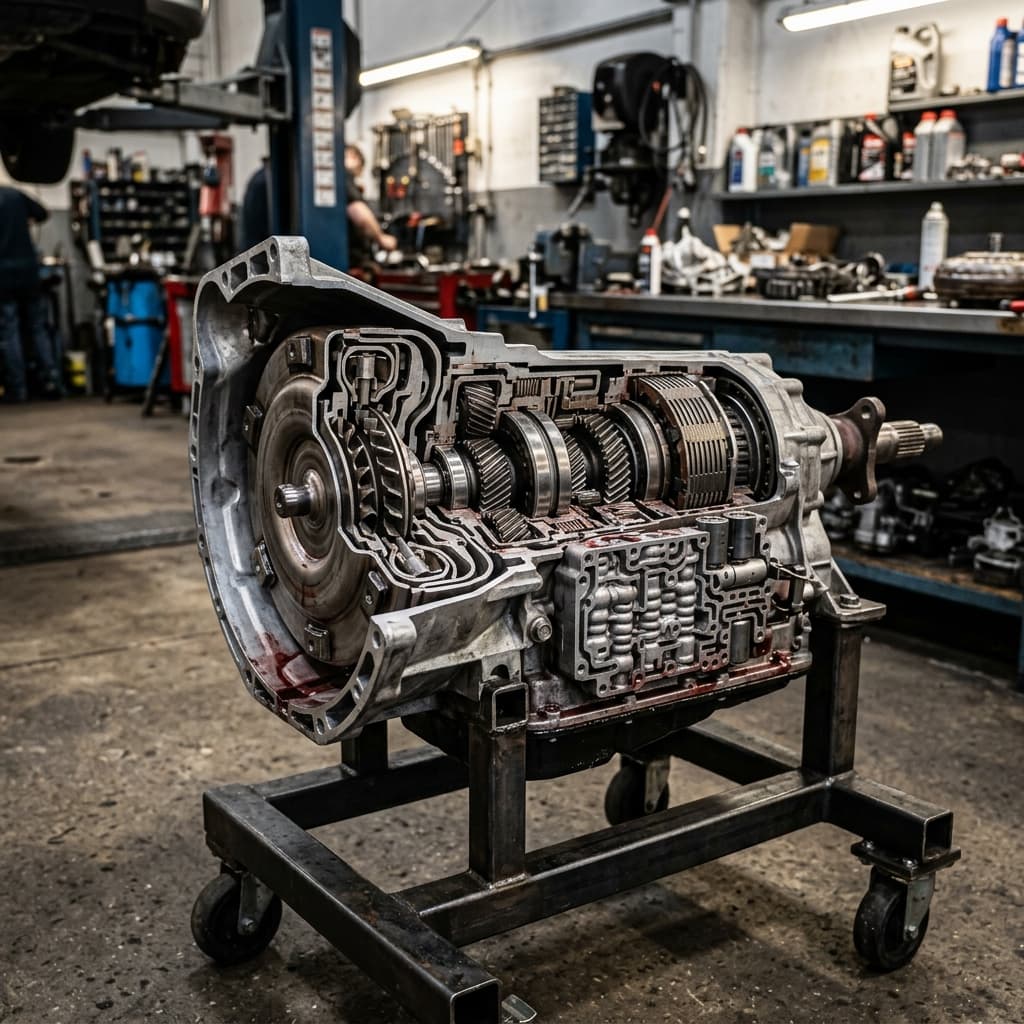
When a transmission slips, the engine revs up but the car doesn't accelerate proportionally. That disconnect — RPMs climbing while speed barely changes — is the clutch packs or bands inside your transmission failing to hold the gear the transmission just selected. The engine is doing its job. The transmission isn't transferring that power to the wheels.
In an automatic, clutch packs are stacks of friction discs clamped together by hydraulic pressure to lock and release specific gear sets. Bands serve a similar function for certain planetary gear combinations. When either wears out, loses hydraulic pressure, or runs out of good fluid, the gear slips under load.
In a manual, slipping usually means the clutch disc itself has worn down to the point where it can't grip the flywheel under torque. The symptoms overlap — RPMs climb, speed doesn't — but the fix is different.
Why slipping is urgent: slipping generates heat. Heat destroys friction material faster. A transmission that slips occasionally becomes one that slips constantly, then one that needs a full rebuild. The repair cost at the fluid stage is $150. At the clutch pack stage, it's $1,500+. That gap is what makes catching this early matter.
What Transmission Slipping Feels Like
Not all slipping feels the same. Here are the six most common symptoms, in order of how frequently drivers notice them:
RPMs flare without acceleration. This is the clearest sign. You press the gas, the tachometer climbs to 3,500 or 4,000 RPM, but the car barely picks up speed. The engine is pulling, the transmission isn't transmitting. This happens most often during acceleration from a stop or when passing at highway speed.
Delayed engagement. You press the accelerator, there's a pause — sometimes half a second, sometimes two full seconds — then the car lurches into gear. The lurch itself is a sign the transmission is having to work harder than it should to engage. This is common in the morning on cold starts as well, but if it's happening after the transmission warms up, that's a problem.
Gear hunting / frequent shifting. The transmission shifts up, then immediately drops back down, then shifts up again — cycling through gears without settling. Under light load this might be subtle; on the highway or going uphill it becomes obvious. The transmission control module is seeing slip and hunting for a gear that holds.
Loss of power under load. Hills, highway merges, towing, a full car — anything that increases load on the drivetrain will expose a slipping transmission faster than flat-road cruising. If the car feels sluggish or underpowered specifically in those situations, start thinking transmission.
Shuddering between gears. A shudder or vibration during gear changes — not a mechanical vibration, more of a whole-car shake that lasts a second or two — often points to a torque converter clutch or worn clutch pack that's engaging and releasing in rapid succession instead of locking cleanly.
Hard, clunky shifts. If shifts have gone from smooth to noticeably abrupt — a thud or jolt when the transmission changes gears — the hydraulic pressure controlling clutch engagement is off. This can be a solenoid issue, a fluid problem, or worn clutch material that can no longer modulate engagement smoothly.
The 6 Most Common Causes of Transmission Slipping
1. Low or Burnt Transmission Fluid
This is the most common cause by a wide margin, and it's critical to understand the difference between *low* and *burnt* — because the repair approach is completely different.
Low fluid means there's a leak somewhere. The transmission is mechanically fine, but there isn't enough fluid to maintain proper hydraulic pressure to engage the clutch packs. Adding fluid and fixing the leak solves it — assuming no internal damage has occurred yet.
Burnt fluid means the fluid has thermally degraded past its useful life. It's lost its viscosity, its additives are depleted, and it can no longer maintain proper pressure or lubricate the friction surfaces. The transmission may have enough fluid by volume, but that fluid isn't doing its job. A fluid change or flush is the fix — unless the fluid has been burnt long enough that the clutch packs themselves are already damaged.
The difference shows on the dipstick. Healthy fluid is bright red with no odor. Burnt fluid is dark brown or black and smells like something scorched. If yours looks or smells burnt, you're past due.
2. Worn Clutch Packs (Automatic) or Clutch Disc (Manual)
In an automatic, clutch packs are stacks of alternating steel and friction plates. They wear with normal use, and once the friction material gets thin enough, they can't hold a gear under load. This is a mechanical wear item — fluid changes can slow the wear, but eventually the packs need to be rebuilt or replaced.
In a manual, the clutch disc is a single disc with friction material on both faces. It sits between the flywheel and pressure plate. Once the friction material wears thin, the disc slips instead of gripping — and you get the same RPM-flare-without-acceleration symptom. Manual clutch replacement is a labor-intensive job because the transmission has to come out to access it.
3. Failed Solenoid
Transmission solenoids are electrically controlled valves that regulate fluid flow and pressure to specific clutch packs. Modern automatics have multiple solenoids — one for each gear, plus a lockup solenoid for the torque converter. When a solenoid sticks open, sticks closed, or develops an electrical fault, it can't modulate pressure correctly, so the clutch pack it controls either won't engage fully or slips under load.
A failed solenoid almost always sets a transmission fault code (P0700 series). If you have a check engine light along with the slipping, pull the codes before assuming the worst — a solenoid replacement is a fraction of the cost of a rebuild.
4. Worn Bands
Automatic transmissions use bands — metal straps lined with friction material — to hold specific gears in the planetary gear set. They work alongside clutch packs and are controlled by the same hydraulic system. Worn bands can slip just like worn clutch packs, and in some cases they can be adjusted externally without opening the transmission. In others, they need to be replaced as part of a rebuild.
5. Torque Converter Failure
The torque converter connects the engine to the transmission in an automatic. At highway speeds, a lockup clutch inside the converter locks engine and transmission together for efficiency. When that clutch wears out or the converter develops internal damage, it can slip — producing the shudder between gears symptom, as well as reduced fuel economy and a transmission that won't fully lock up on the highway.
Torque converter problems are distinct from clutch pack problems, but the driving symptoms overlap. A technician checking transmission fluid condition (converter churns the fluid) and live data — slip RPM, converter clutch duty cycle — can differentiate them.
6. Worn Gear Synchros (Manual)
Synchros are the components inside a manual transmission that match the speed of the gear you're shifting into with the speed of the shaft it's going onto — making shifts smooth. When synchros wear out, the characteristic symptom is grinding going into that specific gear, especially when shifting quickly or when the transmission is cold. It's not slipping in the same sense as the other causes, but it falls under transmission problems and indicates internal wear that will worsen.
How to Check Your Transmission Fluid
Most vehicles built before 2012 or so have a transmission dipstick — usually a red handle, located toward the back of the engine bay on rear-wheel-drive vehicles, or on the side of the transmission on front-wheel-drive vehicles. Check it with the engine warm and running, in Park, on level ground.
Many newer vehicles — especially European brands and some GM, Ford, and Honda products — have sealed transmissions with no dipstick. These require a lift and a drain plug check, or a scan tool that can read transmission fluid temperature and condition indirectly. If your car has no dipstick, a shop visit is the only way to check it.
What you're looking for on the dipstick:
- Healthy fluid: Bright red or light pink, transparent, no smell, level between the min and max marks. Nothing to do.
- Needs service: Dark red or brown, slightly murky, faint smell. Due for a drain-and-fill or flush. Schedule it within the next few weeks.
- Urgent: Dark brown or black, burnt smell — like scorched paper or something electrical. Internal damage may have already occurred. Don't delay service.
- Pink and milky: This is coolant contamination — it means your transmission cooler (which sits inside the radiator on many vehicles) has failed and engine coolant is mixing with transmission fluid. This is a tow situation. Contaminated fluid destroys transmission internals within miles.
Transmission Slipping Urgency: Can You Keep Driving?
Here's the straight answer on whether to drive or tow:
Just low on fluid, no burnt smell, no slipping yet: Add the correct fluid to bring it to level, get the leak found and fixed, and drive to the shop today. Don't wait a week.
Fluid is burnt but transmission is still shifting: Drive directly to the shop — no highway driving, no hard acceleration. You want to minimize heat and load on already-degraded fluid.
Slipping + shuddering + any burnt smell: Seriously consider towing. Every mile of slipping generates heat, and heat damage to clutch packs is cumulative and irreversible. What might be a $500 solenoid job today can become a $3,000 rebuild tomorrow.
Pink or milky fluid (coolant contamination): Tow it. Do not drive. Coolant-contaminated fluid destroys friction material almost immediately — the contamination causes the fluid to foam, which kills hydraulic pressure.
What Does It Cost to Fix a Slipping Transmission?
Repair costs span a huge range depending on what's actually failed. Here's a realistic breakdown:
| Repair | Typical Cost Range | Notes |
|---|---|---|
| Fluid drain-and-fill or flush | $150–$250 | First step for fluid-related slipping; includes filter on most vehicles |
| Solenoid replacement | $250–$500 | Varies by which solenoid and how accessible it is; some are external, some require pan drop |
| Clutch pack rebuild (individual packs) | $500–$1,200 | Selective rebuild if only certain gears are affected |
| Full transmission rebuild | $1,800–$3,500 | All clutch packs, bands, seals, and soft parts replaced; hard parts inspected |
| Remanufactured transmission | $2,500–$5,000 | Warranted unit from a rebuilder; often the best value for badly worn transmissions |
| New OEM transmission | $4,000–$8,000+ | Dealer-sourced; typically only justified for late-model vehicles still under powertrain warranty |
The math here is straightforward: a fluid service at $150–$250 caught early is the best money you can spend. If that same slipping gets ignored for another 10,000 miles and the clutch packs deteriorate, you're looking at $1,800–$3,500 for a rebuild. The fluid didn't cause the problem — the delay did.
For a full overview of what our transmission service includes — fluid service, diagnostic scans, and rebuild or replacement — that page covers the specifics.
Can a Transmission Flush Fix Slipping?
Honest answer: yes, if the slipping is caused by fluid degradation and the mechanical components haven't worn yet. No, if the clutch packs or bands are already damaged.
Here's the distinction between a flush and a drain-and-fill. A drain-and-fill drops the pan, replaces the filter, and refills with fresh fluid — typically replacing 40–50% of the total fluid volume, since the torque converter holds the rest. A flush uses a machine to push all of the old fluid out through the cooler lines while simultaneously filling with new fluid — replacing 90–95% of total fluid volume. A flush does a more thorough job of replacing degraded fluid.
The caveat: do not flush a transmission with severely degraded fluid or a high-mileage transmission that hasn't been serviced in years. Old, degraded fluid can leave varnish deposits throughout the valve body and passages. A flush can dislodge that debris and send it through the transmission, clogging solenoids and valve body passages — potentially accelerating failure rather than preventing it. If you're looking at black, burnt fluid in a transmission that hasn't been serviced in 80,000+ miles, a conservative drain-and-fill (not a flush) and reassessment is the safer approach.
Frequently Asked Questions
Is it safe to drive with a slipping transmission?
For short distances at low speeds, usually — but only to get to a shop. Every slip event generates heat inside the transmission, and heat is cumulative. Driving with a slipping transmission on the highway or under load significantly accelerates the damage. If you're smelling burnt fluid or the slipping is getting worse, tow it.
How long can I drive on a slipping transmission?
There's no reliable mileage number because the answer depends entirely on what's causing the slip and how severely. A transmission slipping due to slightly low fluid might hold up for weeks with minimal additional damage. One slipping due to worn clutch packs can deteriorate from "occasional slip" to "no drive or reverse" in a matter of days if driven hard. The only safe answer is: get it diagnosed before making that call.
Can low transmission fluid cause slipping?
Yes — it's the most common cause. Transmission clutch packs are engaged by hydraulic pressure. Low fluid means lower pressure, which means clutch packs that can't hold their gear under load. Check the dipstick first. If it's low, find out where the fluid went before just topping it off — a transmission doesn't consume fluid the way an engine burns oil. If it's low, there's a leak.
What's the difference between a rebuild and a replacement?
A rebuild (also called an overhaul) means the existing transmission comes out of your vehicle, is disassembled, inspected, and rebuilt with new clutch packs, bands, seals, and gaskets. The hard parts (case, planetary gears, shafts) are reused if they're in spec. A replacement means installing a different transmission — either a remanufactured unit from a rebuilder, or a new OEM unit. A remanufactured unit has already been rebuilt at a facility and comes with a warranty, which can make it faster and sometimes more cost-effective than an in-shop rebuild. The right choice depends on the condition of your current transmission, your vehicle's value, and warranty considerations.
If you're noticing any of the symptoms above — RPM flare, delayed engagement, shuddering, or hard shifts — bring it in. We'll pull any stored fault codes, check fluid condition, and give you an honest diagnosis before recommending repairs. Chloe's Auto Repair & Tire serves North Metro Atlanta from five locations: Roswell, Woodstock, Holly Springs, Canton, and Jasper.