
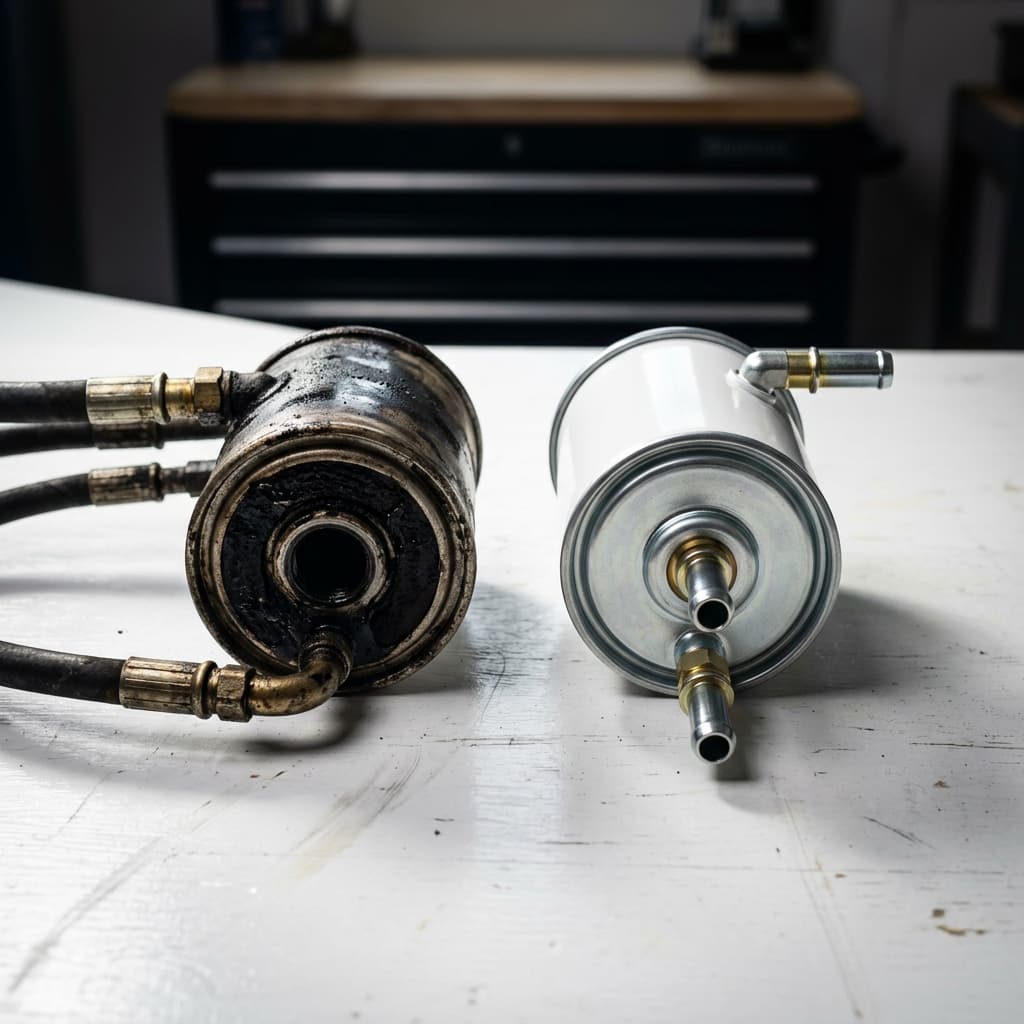
The fuel pump is the heart of your fuel delivery system. Every drop of gasoline or diesel the engine burns gets there because an electric pump — sitting submerged in your fuel tank — pushed it through the fuel lines to the injectors at precise pressure. Unlike brakes or suspension, a failing fuel pump gives you almost no warning before it quits entirely. Which is exactly why understanding the early symptoms can be the difference between a planned repair and a flatbed tow from the highway.
How Your Fuel Pump Works
Modern vehicles use an electric fuel pump mounted inside the gas tank, usually as part of a module that includes the pump, sending unit (which controls the fuel gauge), and a strainer. When you turn the key to the ON position, you can often hear a brief hum as the pump primes the fuel rail — building pressure before the engine cranks.
That pressure matters more than most people realize. Fuel injectors are precision devices that spray atomized fuel into the combustion chamber at a specific rate. They require consistent fuel rail pressure — typically 40–60 PSI on port-injected engines, and anywhere from 1,500–2,200 PSI on direct-injection systems — to deliver the right amount of fuel at the right moment. Low pressure means a lean fuel mixture, which causes misfires, rough idle, and power loss. No pressure means no start.
The 7 Symptoms of a Failing Fuel Pump
1. Whining or whirring noise from the rear of the vehicle. This is the most common early warning sign, and the one most people ignore for months. A healthy pump is nearly silent. A pump that's starting to fail often makes a distinct high-pitched whine that you can hear when you turn the key to ON before cranking. Stand outside the car near the fuel filler and listen on key-on. If you hear it clearly, your pump is struggling. The whine is the electric motor working harder than it should because internal wear has reduced efficiency.
2. Engine sputters at high speed or under load. The pump can maintain adequate pressure at idle and city speeds, but can't keep up at highway speeds or when climbing hills. The engine runs fine around town, then stumbles or surges at 65 mph. This is a classic mid-stage symptom — the pump is failing but not completely gone.
3. Hard starting or long crank before start. A healthy pump primes the fuel rail in 2–3 seconds. A failing pump takes longer to build pressure, so the engine cranks and cranks before catching. This symptom is more pronounced when the engine is hot — heat accelerates the wear in an already-degraded pump motor.
4. Engine stutters or hesitates under acceleration. When you demand more fuel than the pump can deliver — merging onto a highway, passing, or flooring it — there's a momentary pressure drop. The result is a stumble or flat spot during acceleration. Easy, gentle acceleration may be fine; hard acceleration exposes the pressure deficit.
5. Engine stalls on hills or under heavy load. This is a late-stage symptom. The pump simply can't maintain pressure against the increased fuel demand, and the engine stalls. Often the car won't restart immediately — the pump motor is heat-soaked and needs to cool before it can prime again. If your car stalls on a hill but restarts fine after sitting 10–15 minutes, a failing fuel pump is near the top of the suspect list.
6. Fuel pressure test reads low. This is the definitive diagnostic, not a symptom per se — but if a technician connects a fuel pressure gauge to the Schrader valve on your fuel rail and sees pressure below spec, that's hard evidence. Port-injected engines typically need 40–60 PSI at idle; direct injection systems need far more. Low pressure that doesn't recover under snap-throttle points to the pump. Low pressure that recovers points to the pressure regulator.
7. Check engine light with codes P0087, P0191, or P0192. These codes mean the ECU is seeing fuel rail pressure below what it commanded (P0087: fuel system too lean / pressure too low; P0191/P0192: fuel rail pressure sensor signal out of range low). They don't always mean the pump has failed — a clogged filter or faulty pressure regulator can trigger them too — but they're a direct flag to inspect the fuel delivery system. See our fuel system service for what that inspection covers.
The Fuel Pump Failure Progression
Fuel pumps rarely die without warning. They degrade through predictable stages — and most people reach Stage 4 before acting, which adds a tow bill to an already expensive repair.
Stage 1 — Occasional whine, otherwise fine. The pump is starting to wear internally. The whine shows up on key-on, disappears after start. The car drives normally. This is the ideal time to act — pump replacement at this stage is straightforward.
Stage 2 — High-speed sputtering, hesitation under load. The pump can't sustain pressure at full demand. Highway driving and hard acceleration expose the gap. Still drivable around town, but reliability is deteriorating.
Stage 3 — Hard hot-starts, intermittent stalls. The pump is failing under load and struggling to prime when hot. Morning cold-starts might still be fine. Afternoon restarts after a hot engine sits are unreliable. Stalls on hills or during heavy acceleration.
Stage 4 — No start. The pump motor has burned out or seized. No priming whine on key-on. Engine cranks but never catches. You're calling for a tow.
The difference between acting at Stage 1 and Stage 4 is the same pump replacement job — except Stage 4 adds a tow plus the inconvenience of being stranded.
How Mechanics Diagnose a Bad Fuel Pump
A parts-store code read is not a fuel pump diagnosis. Here's what an actual diagnosis looks like:
Fuel pressure test. A gauge is connected to the Schrader valve on the fuel rail (a small fitting, similar to a tire valve stem). The technician checks static pressure at key-on, running pressure at idle, and pressure drop under snap-throttle. Low static pressure, low idle pressure, or a pressure drop that doesn't recover points to the pump.
Volume flow test. A failing pump may hit spec pressure at idle but can't deliver adequate volume under demand. A flow test measures gallons per hour the pump actually delivers — not just what pressure it can briefly build. A pump delivering too little volume will fail at highway speeds even if it looks fine at idle.
Amperage draw test. A failing pump motor draws more electrical current than spec as it works harder to compensate for internal wear. An amp clamp on the pump's power wire while the pump is running reveals this immediately. Above-spec amperage with low pressure is a pump failure, not a wiring or regulator issue.
Code + freeze-frame review. P0087, P0191, and P0192 codes are reviewed alongside freeze-frame data — what the engine was doing when the code set. A code that consistently sets at high RPM or under load points to a delivery problem (pump), not a pressure regulator issue.
Why a code alone isn't enough: P0087 says 'fuel system too lean or fuel pressure too low.' The cause could be the pump, a clogged fuel filter, a leaking fuel pressure regulator, or a leaking injector. Proper diagnosis pinpoints the actual failed component before any parts are ordered.
Can a Clogged Fuel Filter Cause the Same Symptoms?
Yes — and it's worth ruling out first because a filter replacement is far cheaper than a pump. A severely restricted filter forces the pump to work against increased backpressure, which produces almost identical symptoms: sputtering at high speed, hesitation under acceleration, hard starts, and low fuel pressure readings.
On most vehicles built before about 2005, the fuel filter is an external, serviceable component in the fuel line — typically under the car or in the engine bay. Replacement cost: $50–$150 parts and labor. If your vehicle's maintenance history is unknown, replacing the filter first is a reasonable starting point.
On many newer vehicles, the filter is integrated into the fuel pump module inside the tank. There's no separate serviceable filter — the strainer at the bottom of the pump module is the only filtration, and it doesn't get replaced independently. For these vehicles, filter replacement and pump replacement are the same job.
If symptoms persist after a filter replacement on a vehicle with an external filter, the pump itself needs pressure and volume testing.
Fuel Pump Replacement Cost
Most in-tank electric fuel pump replacements fall into this range:
| Component | Typical Cost Range | Notes |
|---|---|---|
| Fuel pump module (part) | $250–$600 | Module includes pump, sending unit, and strainer; sold as an assembly on most modern vehicles |
| Labor | $200–$400 | Varies by access method — some vehicles have a service port under the rear seat or trunk floor; others require dropping the fuel tank |
| Total typical range | $400–$1,000 | Most common vehicles fall in the $500–$800 range at an independent shop |
| Mechanical pump (older carbureted engines) | $100–$250 total | External pump bolted to engine block — simple job, inexpensive parts |
Why OEM or quality aftermarket matters here: A $90 pump from a discount retailer that fails in 18 months costs more in the long run than a $250 quality unit — because you're paying for labor twice. Fuel pump labor is not a quick job on most vehicles. OEM units or quality aftermarket brands (Delphi, Walbro, Carter, Bosch) are worth the premium over budget alternatives.
Labor variation: On some vehicles — particularly certain GM trucks and sedans — there's an access panel under the rear seat or trunk carpet that allows the pump module to come out without dropping the tank. This can cut labor by an hour or more. On other vehicles the tank must be drained, unbolted, and lowered. That labor difference can be $100–$200.
Frequently Asked Questions
How long do fuel pumps last?
Most OEM fuel pumps are designed to last 100,000–150,000 miles or more. Many go 200,000 miles without issue. Premature failure — before 80,000 miles — is almost always caused by one of three things: running the tank consistently low (the pump relies on surrounding fuel for cooling; a near-empty tank runs the pump hot), using contaminated fuel, or a manufacturing defect in a budget aftermarket pump.
Can I drive with a failing fuel pump?
Short distances, cautiously, to get to a shop — yes, if the car is still starting and running. But a pump in Stage 2 or Stage 3 can fail completely without further warning, leaving you stranded wherever it decides to quit. The risk of getting stranded on a highway is not worth it. If you're experiencing stalling or hard hot-starts, have the car towed or drive it directly to a shop without detours.
What makes fuel pumps fail prematurely?
The most preventable cause is consistently running the gas tank below a quarter tank. The pump sits submerged in fuel and uses the surrounding fuel to stay cool. Running near-empty repeatedly causes the pump motor to run hot, accelerating wear on the brushes and armature. Other causes: sediment in the tank from old or contaminated fuel, low-quality replacement pumps with inferior motor construction, and sustained high-demand driving that keeps the pump at full output for extended periods.
Is it the fuel pump or the fuel filter?
Both can produce nearly identical driving symptoms. The diagnostic difference is a fuel pressure test and, if there's an external serviceable filter, its condition. A clogged filter will show low fuel pressure at the rail — but disconnecting the filter and testing pressure at the pump outlet will show normal pressure, meaning the pump is fine. If pressure is low even at the pump outlet, it's the pump. On vehicles without a separate serviceable filter, a pressure and volume test is the only reliable way to differentiate the two.