
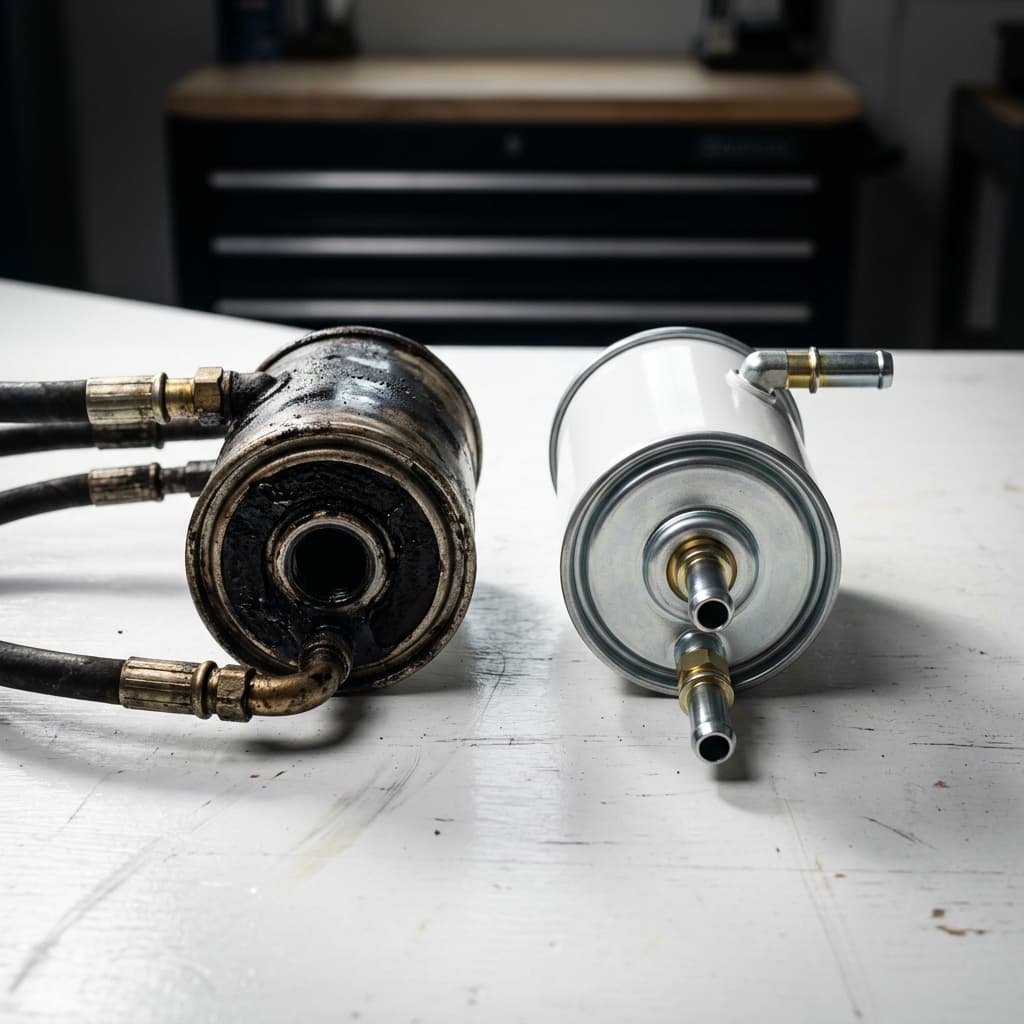
Your fuel filter is one of those components that costs almost nothing when you replace it on schedule — and can cost thousands when you don't. It's a small, inexpensive part that quietly protects your entire fuel system from the debris, rust, and contaminants that accumulate in gasoline over time. When it clogs, the ripple effects touch nearly every part of your engine's fuel delivery chain.
What a Fuel Filter Actually Does
Gasoline isn't perfectly clean. Even fuel from reputable gas stations contains microscopic particles of rust, sediment, and water. Your fuel filter sits between the fuel tank and the fuel injectors (or carburetor on older vehicles), acting as a barrier that traps these contaminants before they can reach and damage precision components.
Modern fuel injectors have tiny orifices — often less than 0.5mm in diameter — that operate at pressures of 40–60 PSI (and up to 2,000 PSI on direct-injection engines). Even small particles can clog or wear these openings. The fuel filter's job is to catch everything that could interfere with that precision.
How a Clog Progresses — Early Warnings vs. Advanced Failure
Early stage (partial restriction): The filter is dirty but not fully blocked. Fuel flow is reduced but still adequate for light loads. Symptoms are subtle: slightly rough idle, very mild hesitation when accelerating from a stop, or a marginal drop in fuel economy. Many drivers attribute this to "just how the car runs" and miss it entirely.
Mid-stage: Restriction is significant. The fuel pump is working harder to push fuel past the clog, building heat and stress. Symptoms become more noticeable — hesitation on acceleration is distinct, you may notice the car stumbles when you ask for more power, and fuel economy has measurably dropped.
Advanced stage: Flow is severely restricted. You may experience frequent stalling, difficulty restarting after stalling, engine surging at idle, and a car that simply won't run under load. At this point, the fuel pump is likely under serious stress.
Symptoms in Detail
Rough Idle
Inconsistent fuel delivery causes the combustion cycle to be uneven. The engine runs irregularly — you may feel a subtle vibration or surging while sitting at a light. This is often the first repeatable symptom.
Hesitation Under Acceleration
When you press the accelerator, the engine demands significantly more fuel. A clogged filter can't deliver it fast enough, creating a lag — sometimes described as the engine "stumbling" or "coughing" before picking up speed.
Stalling
At idle or during deceleration, fuel demand drops, and a partially clogged filter may provide just enough flow. But ask the engine for more and it stalls because the filter can't keep up. Stalling can also happen randomly at low speeds as demand fluctuates.
Hard Starts
Especially after the car has been sitting overnight, a clogged filter may allow fuel pressure to bleed back to the tank. The first start of the day requires extended cranking to re-pressurize the system. Severe clogs can prevent starting entirely.
Poor Fuel Economy
Your engine's ECU detects lean conditions (not enough fuel reaching the injectors) and compensates by commanding more fuel or retarding timing. Both responses hurt economy. A 10–15% drop in MPG is not unusual with a significantly restricted filter.
Where Is the Fuel Filter?
Fuel filter location varies by vehicle type and era:
- Inline filter (most common on older vehicles and some newer ones): Located in the engine bay or along the fuel line under the vehicle, between the tank and engine. Usually a cylindrical canister with fuel line connections at each end. Straightforward to replace.
- In-tank filter / strainer: Many modern vehicles integrate the fuel filter into the fuel pump module inside the tank. Replacement means dropping the tank and accessing the pump assembly — a more involved job. Some manufacturers call this filter "lifetime" and don't publish a replacement interval, though most technicians recommend inspection when symptoms appear.
- Carbureted engines (older vehicles): A small inline filter, often glass or clear plastic, is located between the fuel line and carburetor inlet. Cheap and easy to replace — often under $10.
Diagnosis — Fuel Pressure Testing
The most reliable way to confirm a clogged fuel filter is a fuel pressure test. A technician connects a gauge to the fuel rail (the distribution line that feeds the injectors) and measures system pressure:
- Healthy pressure: Typically 40–60 PSI for port-injected engines, and up to 2,000+ PSI for direct injection. The exact spec depends on your vehicle.
- Low pressure at idle: Points to a weak fuel pump or clogged filter.
- Pressure drop under load: If pressure drops when RPMs increase, the filter cannot pass fuel fast enough — a clear sign of restriction.
- Pressure bleed-down: If pressure drops significantly after the pump shuts off (key off), a check valve or filter issue may be preventing pressure retention.
A filter that's "borderline" may pass at idle and fail only under acceleration — which is why fuel pressure should ideally be tested both at idle and under simulated load.
Replacement Cost
The part: An inline fuel filter typically costs $15–$70 for most domestic vehicles. Import filters can run $30–$150. The in-tank integrated filter/pump assembly is significantly more expensive: $150–$600 for the part alone.
Labor: A standard inline filter replacement is a straightforward job — $50–$100 in labor at most shops. An in-tank filter requiring fuel pump module removal can run $150–$350 in labor depending on tank access and vehicle design.
Total cost: $65–$200 for an accessible inline filter. $300–$800+ for an integrated in-tank assembly replacement. This is why keeping up with scheduled filter changes on accessible filters is far cheaper than waiting for symptoms to force the issue.
What Happens If You Ignore a Clogged Fuel Filter
A clogged filter doesn't just inconvenience you — it creates a chain reaction of increasingly expensive damage:
Fuel pump failure: Your electric fuel pump is designed to push fuel at a set resistance. When a clogged filter makes it work harder than designed, the pump motor runs hotter and fails prematurely. A fuel pump replacement typically costs $400–$900 — many times the cost of a filter change.
Fuel injector damage: If debris gets past a compromised filter, or if pressure fluctuations create uneven spray patterns, injectors can clog or wear. Professional injector cleaning costs $100–$200. Replacement runs $300–$800+ depending on the engine.
Catalytic converter damage: Lean running conditions and misfires caused by fuel starvation can send unburned fuel into the exhaust, damaging the catalytic converter. A catalytic converter replacement costs $500–$2,500 depending on the vehicle.
The bottom line: Replacing a fuel filter on schedule for $65–$200 is straightforward preventive maintenance. Ignoring it risks $1,000–$4,000+ in downstream repairs.
Frequently Asked Questions
How do I know if my fuel filter is clogged?
The most common signs are rough idling, hesitation when accelerating, stalling (especially under load), hard starts, and reduced fuel economy. A professional fuel pressure test is the most reliable confirmation. If you're experiencing two or more of these symptoms simultaneously, the fuel filter is a logical first thing to check — it's inexpensive to replace and rules out a simple cause before investigating more complex ones.
How much does fuel filter replacement cost?
For a standard accessible inline filter: $65–$200 total (part + labor). For an integrated in-tank assembly: $300–$800+. Cost varies by vehicle make, model, and where the filter is located. Ask your technician for a specific quote based on your vehicle.
How often should I replace my fuel filter?
The traditional interval is every 30,000 miles, though many modern vehicles with in-tank filters are listed as "lifetime." Practically speaking, if your vehicle has an accessible filter and is over 60,000 miles with no replacement record, it's worth doing. For in-tank filters, replace proactively when the fuel pump is replaced, or when symptoms appear.
Can a clogged fuel filter damage other components?
Yes — significantly. A clogged filter forces the fuel pump to work harder, shortening its life. It can allow debris to reach injectors if pressure fluctuations dislodge accumulated particles. Lean running conditions from fuel starvation cause misfires that can damage the catalytic converter. What starts as a $100 filter job can cascade into $2,000+ in repairs if left unaddressed.
If you're noticing rough running, hesitation, or hard starts, Chloe's Auto Repair & Tire can perform a fuel pressure test and inspect your fuel filter at any of our locations in Woodstock, Marietta, Roswell, or Spring, TX. We'll tell you what's actually causing the problem before recommending any repair.