
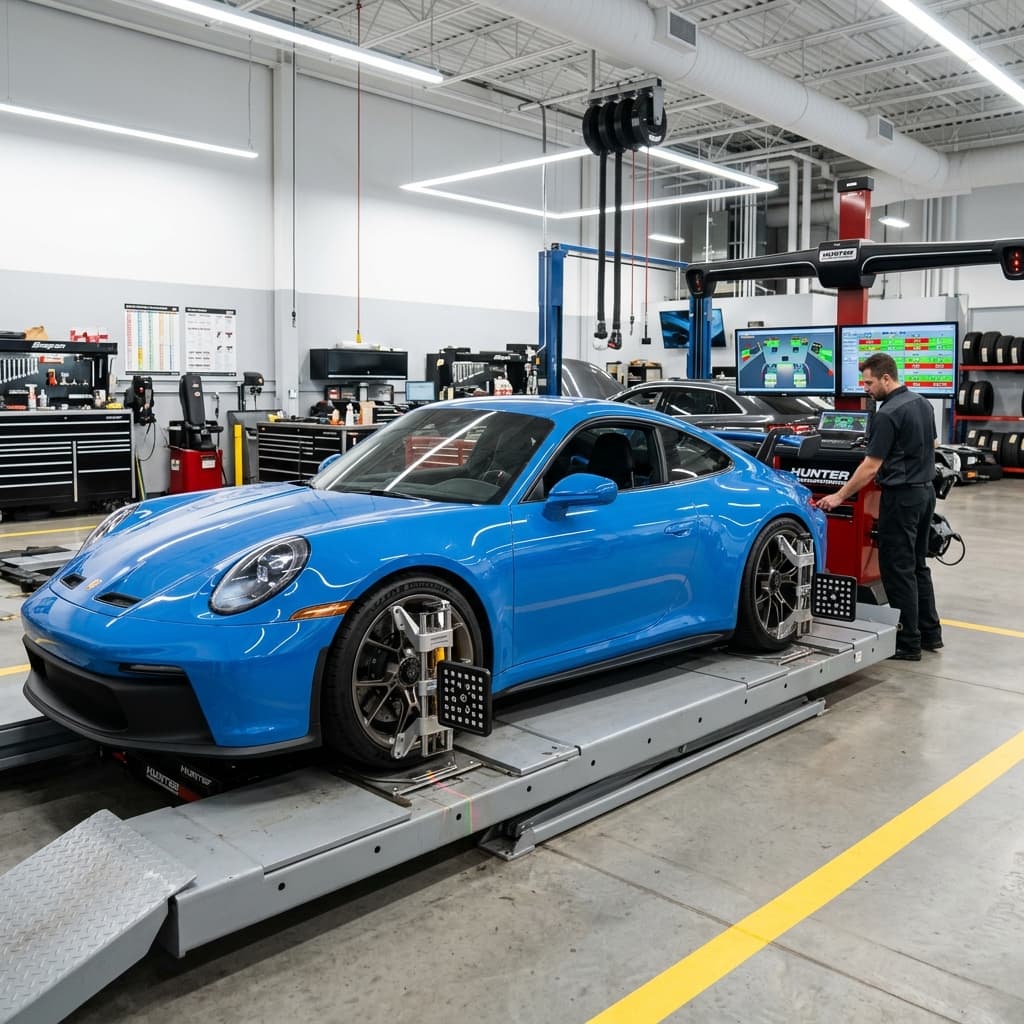
That annoying steering wheel vibration that starts around 60 mph and goes away at 70? It's one of the most recognizable signs of unbalanced wheels — and one of the most commonly ignored. Wheel imbalance is gradual and easy to dismiss as "just the road," but left unchecked, it quietly chews through your tires, strains your wheel bearings, and rattles your suspension components. Here's everything you need to know.
What Is Wheel Balancing?
Every tire and wheel assembly has tiny weight variations left over from manufacturing. Even a difference of a fraction of an ounce can cause the assembly to spin unevenly at highway speeds. Wheel balancing corrects this by attaching small calibrated weights to specific points on the rim, so the entire rotating assembly spins smoothly and symmetrically.
A tire placed on a balancing machine reveals exactly where the heavy spots are and how much correction is needed. The machine calculates the precise weight and placement, and a technician clips or adhesive-mounts the weights accordingly. The whole process usually takes 15–20 minutes per wheel.
Symptoms of Unbalanced Wheels
1. Steering Wheel Vibration (Especially at 60–70 mph)
This is the hallmark symptom. You'll feel a buzzing or shaking in the steering wheel that typically begins around 55–65 mph and may smooth out again above 70 mph. The vibration is speed-dependent (not engine-RPM-dependent), which is the key clue. If the imbalance is in the front wheels, it's most noticeable through the steering wheel. If it's in the rear, you'll feel it more through the seat or floorboard.
2. Seat or Floorboard Vibration
Rear wheel imbalance often transmits through the car's structure rather than the steering column. Passengers notice it as a buzzing or shaking sensation in the seat, particularly on smooth highways where road noise isn't masking it.
3. Uneven Tire Wear — Cupping and Scalloping
Unbalanced tires bounce as they spin instead of rolling smoothly. That bouncing creates a distinctive wear pattern called cupping or scalloping — a series of dips and humps worn into the tread around the circumference of the tire. Run your hand around the tire edge and feel for this pattern. Cupped tires also make a rhythmic thumping noise that worsens with speed.
Important distinction: cupping from imbalance appears around the circumference, while alignment problems typically cause wear across the width (feathering or edge wear).
4. Rhythmic Humming or Thumping Noise
A humming, buzzing, or thumping sound that increases with vehicle speed (not engine speed) is a common imbalance symptom. It's the sound of the tire making uneven contact with the road surface as it bounces through each rotation.
Wheel Balance vs. Wheel Alignment — What's the Difference?
These two services are commonly confused, but they correct different problems:
- Wheel balancing corrects uneven weight distribution in the tire/wheel assembly. It addresses vibrations.
- Wheel alignment corrects the angles of the wheels relative to each other and to the road. It addresses pulling, drifting, and uneven edge wear.
How to tell which you need: If your car vibrates at speed → suspect balance. If your car pulls to one side or wanders → suspect alignment. Many vehicles benefit from both at the same time, especially after hitting a significant pothole.
When Do Wheels Go Out of Balance?
- Hitting a pothole or curb — the sudden impact can knock off a wheel weight or slightly deform the tire.
- Lost wheel weight — weights clip or adhesive-bond to the rim and can fall off from corrosion or road debris.
- New tire installation — all new tires must be balanced when mounted; never skip this step.
- Normal tire wear — as tread wears down unevenly over time, the balance shifts.
- Bent wheel — a significantly bent rim from a hard impact cannot be fully corrected by balancing alone and may need straightening or replacement.
How Balancing Is Done
There are two main methods:
- Static balancing — the wheel spins on a vertical axis and heavy spots are detected when one side drops. Simple but less precise for modern tires.
- Dynamic balancing (spin balancing) — the wheel is spun at speed on a computerized machine that measures imbalance in two planes simultaneously. This is the standard method at professional shops and is significantly more accurate.
- Road force balancing — an advanced technique that simulates the weight of the vehicle pushing down on the tire as it rolls. A large roller presses against the spinning tire to measure variation. This is used for stubborn vibrations that don't respond to standard balancing, and can detect tire "flat spots" and stiff spots in the sidewall.
How Much Does Wheel Balancing Cost?
Wheel balancing is one of the most affordable maintenance services available:
- Per wheel: $15–$25
- All four wheels: $60–$100
Many shops include balancing with tire rotation, so your cost per service may be lower if bundled. Road force balancing, when required, typically costs $20–$40 per wheel due to the specialized equipment involved.
How Often Should You Balance Your Wheels?
- Every 12,000–15,000 miles as routine maintenance
- Every tire rotation (recommended every 5,000–7,500 miles)
- After hitting a significant pothole or curb
- Whenever you feel vibration at highway speeds
- Any time new tires are installed
If you're getting regular tire rotations at Chloe's, your technician will also check for the need to rebalance — catching it before it becomes a problem.
What Happens If You Ignore Unbalanced Wheels?
Ignoring imbalance doesn't just mean putting up with a vibration. Over time:
- Tires wear out faster — cupped tires may need replacement thousands of miles earlier than properly balanced ones.
- Wheel bearings wear prematurely — the constant oscillation puts lateral stress on bearings that aren't designed for it.
- Suspension components loosen — the repeated vibration can cause fasteners and bushings to wear, leading to noise and handling issues.
- Driver fatigue increases — subtle constant vibration is surprisingly draining on long highway drives.
FAQ: Wheel Balancing
How do I know if my tires are out of balance?
The clearest sign is a steering wheel or seat vibration that starts between 55–70 mph and is speed-dependent. You can also look for cupping wear patterns on your tires. When in doubt, a technician can spin-balance your wheels in about 20 minutes to confirm.
How much does wheel balancing cost?
Expect to pay $15–$25 per wheel, or $60–$100 for all four. Many shops bundle balancing with tire rotations, lowering the effective cost per service.
Balance vs. alignment — what do I need?
If you're experiencing vibration at highway speeds, you likely need balancing. If your vehicle pulls to one side or your tires are wearing unevenly across the width (edge wear), you likely need alignment. If you're not sure, ask your technician — both can be inspected quickly.
Can unbalanced wheels damage my car?
Yes. Over time, imbalance accelerates tire cupping, wears out wheel bearings faster, and can loosen suspension components. It's a small maintenance item that prevents much larger repair bills.
Visit Chloe's Auto Repair & Tire
Wheel balancing takes about 20 minutes and can be done at any of our locations in metro Atlanta, Roswell, and Spring, TX. If you're feeling a highway vibration or due for a tire rotation, stop by — we'll spin-balance your wheels, check the tread, and tell you exactly what your tires need. Need alignment too? Visit our Tires & Wheel Alignment service page to learn more.